Tag: Neutral

  • Crypto Firms Urge Senate Vote on CLARITY Act Before July 4

    Crypto Firms Urge Senate Vote on CLARITY Act Before July 4

    Crypto Industry Urges Senate Vote on CLARITY Act Amid Tight Deadline

    More than 200 cryptocurrency companies have jointly penned a letter to Senate Majority Leader John Thune and Minority Leader Chuck Schumer, demanding an immediate floor vote on the CLARITY Act. Among the prominent signatories are Coinbase, Ripple, Kraken, Circle, Binance US, and Andreessen Horowitz.

    The bill previously cleared the Senate Banking Committee with a 15-9 vote on May 14 and was added to the General Orders Calendar by June 1. However, no floor vote has yet been scheduled.

    The pressure is mounting, and the legislative window is rapidly closing. The White House has set an unofficial July 4 deadline, while Congress faces an August recess, and the Senate’s floor schedule is already heavily burdened with competing legislative priorities.

    A coalition, including Stand With Crypto and over 200 other organizations, has conveyed a clear message to Senate leadership: it is time for the CLARITY Act. The crypto community, encompassing large corporations, startups, associations, and grassroots groups nationwide, is united in its expectation that lawmakers will deliver regulatory clarity.

    Galaxy Digital estimates the bill’s chances of becoming law at approximately 60%. This figure reflects both the genuine political momentum behind the legislation and the significant procedural hurdles that remain before a Senate vote can occur.

    Treasury Secretary Scott Bessent and White House Crypto Advisor Patrick Witt have publicly urged lawmakers to advance the CLARITY Act for a potential July 4 signing by President Donald Trump, framing the date as an administration-level expectation rather than a mere suggestion. This leaves the Senate with roughly three weeks of legislative working time before the symbolic deadline loses its impact.

    The path to a vote is complex. Senator Thune would need to formally schedule debate, allow for amendments through a manager’s amendment process, navigate any procedural challenges, and secure 60 votes for cloture before the chamber recesses.

    Senator Cynthia Lummis has indicated strong political will, stating, “We did not come this far to quit at the 5-yard line.” However, political will alone does not guarantee floor scheduling.

    Procedural Hurdles and Committee Reconciliation

    A crucial, often overlooked, step is the reconciliation process. The version of the CLARITY Act passed by the Senate Banking Committee must be merged with the Senate Agriculture Committee’s Digital Commodity Intermediaries Act. This is necessary because the CLARITY Act’s framework divides jurisdiction between the Securities and Exchange Commission (SEC) and the Commodity Futures Trading Commission (CFTC), with both committees having claimed oversight. This merger is not yet complete. If a vote does not occur before the recess, the July 4 target will be missed, and the political opportunity may not reappear under the same conditions.

    The Senate’s filibuster rule requires 60 votes to advance major legislation to a final passage vote. With Republicans holding 53 seats, the CLARITY Act would need at least seven Democratic crossovers. A prior procedural motion in March garnered 64 votes, suggesting theoretical achievability, but a procedural motion is structurally less demanding than a full cloture vote on a contentious market-structure bill.

    The bill secured two Democratic votes in committee: Senator Ruben Gallego of Arizona and Senator Angela Alsobrooks of Maryland. Transitioning from two to seven Democratic votes on the full floor presents a different challenge.

    Unresolved Concerns and Industry Opposition

    Lingering Democratic concerns include an ethics provision tied to President Trump’s personal cryptocurrency holdings, a sticking point that remains publicly unresolved and could alienate potential supporters under floor pressure.

    The banking industry’s opposition represents another significant obstacle. JPMorgan CEO Jamie Dimon has pledged to challenge provisions related to stablecoin yields and what he describes as inadequate bank-equivalent regulation for stablecoin issuers.

    The CLARITY Act’s proposed structure, which categorizes digital assets as SEC-regulated securities, CFTC-regulated digital commodities, or stablecoins under joint oversight, directly challenges the competitive standing of traditional finance in payment infrastructure. Dimon’s stance suggests the banking lobby will actively engage in the floor debate. While the bill passed committee 15-9, achieving 60 votes on the floor is a fundamentally different challenge.

    Key Indicators for the Path Forward

    The most critical signal will be whether Senator Thune’s office formally adds the CLARITY Act to the active Senate floor schedule within the next two weeks. The introduction of a manager’s amendment addressing the ethics provision and the Agriculture Committee reconciliation would indicate progress toward a genuine vote, rather than further procedural delays.

    Attention will also be focused on whether Dimon and the banking lobby intensify their opposition or, under White House pressure, moderate their stance on the stablecoin yield provisions.

    The July 4 deadline is a political construct, not a legal mandate. However, such political constructs define legislative windows. If the Senate fails to act before its recess, the cryptocurrency industry will require a new opportunity, and these do not typically arise on a predictable schedule.

  • XRP’s Future Shifts: Path to $10 Rally Amidst Disappointment

    XRP Price Faces Downtrend Despite Long-Term Optimism

    After years of subdued performance, the XRP cryptocurrency saw a significant rebound in 2024, nearing its all-time high of $3.8 but ultimately falling short. This surge followed the resolution of a protracted legal battle with the U.S. Securities and Exchange Commission (SEC) in the same year, which ignited a wave of recovery. However, the momentum proved short-lived, with XRP’s price appearing to hit a ceiling and entering a downtrend that has persisted for over a year. This decline has pushed the price towards the $1 mark, representing a drop of more than 60% from its 2024 peaks.

    Despite this recent downturn, predictions persist that XRP’s price will eventually surpass $10, underscoring its continued popularity within the cryptocurrency landscape.

    The Evolving “XRP Dream”

    Crypto analyst Crypto Patel recently shared insights on the shifting investor mindset regarding XRP’s price trajectory. On the social media platform X (formerly Twitter), Patel highlighted how the aspiration for XRP was once to simply reach $1, a goal that seemed distant when the digital asset traded around $0.003 in 2017.

    In a notable turn of events, the $1 level that once represented a significant milestone for XRP holders has now become a point of concern for many. However, Patel argues against joining this chorus of complaint, emphasizing that even the current price point represents a substantial improvement from XRP’s historical lows. With XRP trading above $1, it signifies an impressive rally of over 37,000% from its lowest points. Therefore, what is currently perceived as a decline could, from a different perspective, be viewed as a cause for celebration.

    Accumulation Strategy Amidst Market Sentiment

    With current market sentiment weighing on investors, Crypto Patel is identifying lower price levels as opportune moments to begin accumulating XRP again. The analyst points to $1 as the primary accumulation zone, which would entail a decline of over 10% from the price at the time of this report.

    Further down, Patel suggests that XRP’s price could potentially fall as low as $0.6. This would establish an accumulation range between $0.6 and $1, indicating an expectation that the market bottom will likely occur within these levels.

    Despite these short-term price considerations, the analyst maintains that the long-term target of $10 for XRP remains achievable. The prevailing bullish narrative for XRP’s long-term prospects continues to hold strong, with patience and time being key factors in realizing its potential price appreciation.

  • DOGE Faces 32% Crash or Rally: Two Scenarios Emerge

    DOGE Faces 32% Crash or Rally: Two Scenarios Emerge

    Dogecoin experienced a modest rebound on Monday, climbing to approximately $0.086 after dipping to a multi-year low of $0.077 over the weekend. Market analyst Ali Martinez has released a technical update suggesting that DOGE is currently at a “critical structural inflection point,” offering two potential paths forward based on chart patterns and on-chain activity.

    Is A Macro Expansion Cycle Next?

    Martinez posits that Dogecoin is resting on a significant demand base that has historically underpinned major macro expansion cycles. He views the current situation as more than a fleeting recovery, citing long-term structural behavior. According to his analysis, Dogecoin has historically navigated extended, multi-year consolidation phases, characterized by compressed volatility and gradual supply transfer. These periods, he argues, typically precede substantial bull markets.

    The analyst notes that Dogecoin is presently testing a crucial technical area at $0.081, just below its current trading price. This level aligns with the lower mid-range boundary of a five-year parallel channel. Martinez emphasized that this key chart level is bolstered by on-chain support, referencing the UTXO Realized Price Distribution (URPD) data. This metric tracks the price points at which tokens in circulation were last moved.

    Martinez highlighted a significant cluster around $0.081, with over 30 billion Dogecoin tokens having been transacted at approximately this price. This concentration of historical activity, he explained, often forms a psychological and financial “wall of defense,” making it challenging for sellers to drive the price lower.

    Two Scenarios For Dogecoin

    Martinez identified two key levels to monitor: $0.081, where the URPD volume cluster intersects with the channel’s mid-range, and $0.058, which he terms the multi-year absolute channel floor.

    He then outlined two potential scenarios. In Scenario A, if the $0.081 volume block successfully absorbs market supply and this support holds, Martinez anticipates a more stable rebound and expansion towards higher channel targets.

    Scenario B presents a more cautious outlook. Martinez suggested that if macroeconomic headwinds intensify and Dogecoin closes a weekly candle below $0.081, the chart structure would shift into what he described as an “extended valuation reset.” In this event, the token could be pushed towards the lower end of the macro channel, potentially reaching the $0.058 support floor. This would represent a further 32% decline for the memecoin.

  • XRP Surges Past $10: Data Confirms Bullish Trajectory

    XRP Surges Past $10: Data Confirms Bullish Trajectory

    XRP Faces Potential Liquidity Sweep Before Significant Upside, Analyst Suggests

    XRP’s price has experienced considerable downward pressure in recent days, mirroring broader market trends. The cryptocurrency has retreated to a critical support zone around $1.10, with sellers maintaining control of short-term momentum. This decline has positioned XRP squarely within a significant area on its long-term monthly candlestick chart.

    XRP in a “Face-Melting Phase”

    Technical analysis by crypto analyst EGRAG CRYPTO indicates that XRP may undergo one final liquidity sweep before embarking on a substantial rally potentially exceeding $10. EGRAG’s assessment is based on XRP’s behavior on higher timeframes, specifically around the 50-month and 100-month exponential moving averages (EMAs).

    According to the analyst, XRP has historically followed a recurring pattern after decisively losing the 50 EMA. This breakdown is typically characterized by weak momentum, emotional selling, and a concluding liquidity sweep towards the 100 EMA before a new rally commences.

    The current monthly candle has opened below the 50 EMA, placing XRP’s price action in a precarious position. This scenario, described as a “face-melting phase,” suggests a possibility of further decline towards the 100 EMA as the market continues to seek its macro bottom. EGRAG’s projected path anticipates further downside, with charts indicating a potential drop below $1.

    Building a Position Amidst Uncertainty

    Intriguingly, while anticipating further declines, EGRAG CRYPTO is actively accumulating XRP. Instead of waiting for a confirmed reversal, the analyst is building a position across a range of entry prices, including $1.09, $0.92, $0.85, and even $0.70, treating each level as a potential probability zone.

    Projections Point to Over $10

    Beyond the immediate downside potential, EGRAG’s analysis highlights significant upside targets. The projected recovery path suggests XRP could break above its current cycle high of $3.65. The charts indicate potential upside levels at $9, $13, $17, $20, and $27.

    EGRAG emphasizes that the precise bottom may become less critical if XRP ultimately reaches these projected bullish targets. The analyst argues that effective risk management is more crucial than pinpointing the exact bottom. His strategy illustrates that entering at lower prices like $1.09, $0.92, $0.85, or $0.70 would yield substantial returns if XRP reaches targets of $7, $8, $13, or even mid-double-digit figures.

    At the time of reporting, XRP was trading at $1.14, marking a 12% decrease over the past seven days. A move from the current price to $10 would necessitate a rally of approximately 777%. Reaching $13 would represent a gain of over 1,040%, while a surge to the $27 level on the chart would require XRP to increase by more than 2,260% from its current trading range.

  • OpenAI Files Confidentially for IPO, Timing Undisclosed

    OpenAI Files Confidentially for IPO, Timing Undisclosed

    OpenAI Confirms Confidential IPO Filing, Signaling Public Market Ambitions

    OpenAI, the artificial intelligence powerhouse behind ChatGPT, confirmed on Monday that it has submitted a confidential S-1 registration statement to the U.S. Securities and Exchange Commission (SEC), marking a significant step toward a potential initial public offering (IPO). This filing formally initiates the process for the company to become publicly traded.

    “We recently submitted a confidential S-1,” the company stated in a post on X. “We expect it to leak, so we’re just announcing it.”

    The S-1 document is a crucial registration filing that companies must submit to the SEC before offering shares to the public. A confidential filing allows regulatory bodies to commence their review of the necessary paperwork before sensitive financial details are disclosed to the wider market.

    However, OpenAI cautioned that this filing should not be construed as an indication that an IPO is imminent.

    “We have not decided on timing yet; it may be a while because there are things we want to do that are likely easier as a private company,” OpenAI explained. The company added that the filing provides it with “the option to go public sooner if that ends up being best.”

    This announcement follows months of persistent speculation regarding OpenAI’s preparations for a public listing. In May, The Wall Street Journal reported that the company was contemplating a September IPO and had enlisted Goldman Sachs and Morgan Stanley to advise on the offering. That report emerged shortly after the dismissal of a lawsuit filed by Elon Musk, which had challenged OpenAI’s corporate structure and presented a notable legal hurdle.

    OpenAI is not the only prominent artificial intelligence firm charting a course toward public markets. Earlier this month, competitor Anthropic disclosed its own confidential IPO filing. Separately, Elon Musk’s aerospace company, SpaceX, revealed its IPO plans in May.

  • ChatGPT XRP Price Prediction Defies Logic

    ChatGPT XRP Price Prediction Defies Logic

    ChatGPT AI Flags XRP Price Prediction, Targeting $3 to $7

    A recent analysis from ChatGPT AI has put forth a bold price prediction for XRP, suggesting a potential reclaim of the $3 to $5 range, with an ambitious stretch target near $7 within the current cycle. This forecast stands in stark contrast to XRP’s current trading price of approximately $1.14, implying a significant threefold to sixfold increase from a level that has left many holders frustrated.

    The Bull Case: A Shift in Sentiment and Fundamentals

    The optimistic outlook for XRP hinges on a fundamental shift in market sentiment. While it might seem improbable now, just in late 2024, the idea of XRP holders being dissatisfied with prices above $1 would have been met with disbelief.

    The broader cryptocurrency market has lagged behind the strong performance of traditional stocks. However, this mirrors past cycles where the sector was prematurely declared dead before a significant sentiment turnaround.

    From a fundamental perspective, XRP is arguably in its strongest position ever. This is attributed to improved regulatory clarity, growing institutional interest, expanding utility, and a more mature market structure. Should capital begin to flow back into cryptocurrencies through 2026 and risk appetite increase, the predicted reclaim of the $3 to $5 range and a push towards $7 appears plausible.

    The Bear Case: A Slow Grind, Not a Collapse

    Conversely, the bearish scenario anticipates a slower, grinding market rather than a sharp collapse. If adoption rates continue to trail expectations and capital remains concentrated in Bitcoin and equities, XRP could find itself trading between $1 and $2 for an extended period.

    This scenario highlights the challenge for a coin with sound fundamentals but a lack of fresh capital inflows. Nevertheless, from a risk-reward perspective, XRP appears to be closer to a point of capitulation than euphoria. Historically, such periods have often preceded significant price movements.

    Chart Analysis: A Beaten-Down Landscape

    Currently, XRP’s daily chart shows the price at $1.14, a considerable drop from its July high of $3.60. The technical structure exhibits a clear pattern of lower highs and lower lows, indicative of a downtrend that recently printed a local low near $1.05. This descending staircase pattern suggests that the price is attempting a minor bounce from this low.

    Key support levels are identified at $1.10, with the next significant support zone around $1.00 and major demand emerging at $0.80. Resistance is stacked at $1.40, followed by $1.60, and a more substantial zone at $1.80.

    The Relative Strength Index (RSI) is currently at 30.88, with its signal line at 32.19. This indicates that momentum is just below average and pressing into oversold territory. The narrow gap between the RSI and its signal line suggests that selling pressure is waning rather than intensifying. A move back above 32.19 would be the initial signal that the downward trend is losing steam.

    In summary, the chart reflects a deeply oversold asset, which aligns with the conditions required for the ChatGPT AI’s prediction. A reclaim of the $1.40 resistance level could open the door for a move towards $3 and beyond.

    The Importance of Positioning in Crypto Cycles

    Market cycles do not reward patience at resistance levels; they reward strategic positioning before a significant move. Bitcoin, Ethereum, and XRP are all testing resistance bands that have held them back for weeks. Macroeconomic catalysts, such as key data prints, and institutional inflows are always on the horizon, often just a quarter away. The current ceiling for these large-cap assets is visible, and waiting for a breakout often means relying on decisions made by others.

    Early-Stage Infrastructure and Undiscovered Opportunities

    Early-stage infrastructure projects operate in a different market dynamic. Capital that would have a negligible impact on Bitcoin’s price can dramatically reprice smaller-cap projects. The opportunity lies in the discrepancy between a project’s intrinsic value and its current market valuation, a gap that exists primarily while the project remains undiscovered. Once discovered, this gap tends to close permanently.

    LiquidChain: Addressing Multi-Chain Fragmentation

    The fragmentation of multi-chain ecosystems has been a persistent issue in decentralized finance (DeFi) since the inception of cross-chain bridges, with no effective solution yet implemented. Bitcoin, Ethereum, and Solana were built as independent systems lacking native interoperability. Every transaction that crosses these boundaries incurs costs in fees, slippage, and execution failures. Bridges, rather than solving the problem, have effectively monetized it.

    LiquidChain aims to eliminate this issue by consolidating three networks into a single execution layer. Developers can deploy applications once, and users can interact across all ecosystems without incurring cross-chain transaction taxes.

    ChatGPT AI has identified LiquidChain as a project worth monitoring. Its presale is currently priced at $0.01454, with over $820,000 raised.

    It is important to acknowledge the inherent execution risks and unproven adoption for LiquidChain. Established assets offer a more predictable path to a ceiling that is already largely priced in. LiquidChain represents an opportunity to participate in a nascent ecosystem that is still under development.

  • Pi Network Plunges 12% Weekly; Recovery Triggers Eyed

    Pi Network Plunges 12% Weekly; Recovery Triggers Eyed

    Crypto Market Sees Modest Gains, Pi Network Struggles

    The cryptocurrency market experienced a slight but noticeable recovery over the past 24 hours, with most major digital assets showing upward movement. However, Pi Network’s native token, PI, continues to trade in negative territory, facing persistent downward pressure.

    One analyst suggests a potential turnaround could be on the horizon, identifying a key factor that might spark a rebound for the embattled token.

    Last week, PI briefly dipped below $0.12, marking its lowest point since its inception. While it has since recovered some of those losses, the token is currently trading just under $0.13. This represents a 12% decline over the past week and a dramatic 96% drop from its all-time high recorded in February 2025.

    X user Erick Crypto ₿ observed that PI’s price has attempted to stabilize following an extended downtrend. He noted that trading volume remains low, indicating that “confirmation is still needed.”

    The analyst also pointed out that PI’s Relative Strength Index (RSI) has approached oversold levels. This suggests that the token’s valuation has fallen too rapidly, potentially setting the stage for a recovery. The analyst concluded that the future trajectory now depends on buyer behavior: “If buyers step in, we could see a recovery move from these depressed levels. However, risk management remains essential until a clear trend reversal appears.”

    Despite these price struggles, the Pi Network team has recently achieved several significant milestones and released multiple announcements concerning the ongoing development of the project’s ecosystem.

    Most recently, the team announced the successful transition to protocol v24. This upgrade is primarily designed to enhance the underlying infrastructure supporting node operations and mainnet activity. The Core Team has indicated that the migration to v25 is the next item on the roadmap, with a deadline set for June 18.

    Prior to this, CiDi Games, a company within the Pi Network Ventures portfolio, introduced four new games for “Pioneers”: Coin Whack, Fruit Stack, Gemnova, and RainbowCubes.

    These developments have so far failed to catalyze a price recovery for PI. The community’s attention has now shifted to June 28, a date known as Pi2Day. Some users on X are speculating about potential announcements, ecosystem updates, or new features that might be unveiled on this day. However, no official confirmations have been made, and it remains uncertain whether these expectations will be met or if they will have any impact on PI’s valuation.

  • Hayes Denies $2M HYPE Buy Allegation

    Hayes Denies $2M HYPE Buy Allegation

    Hayes Denies $2 Million HYPE Token Purchase Amidst Community Backlash

    BitMEX co-founder Arthur Hayes has reportedly denied purchasing 33,978 HYPE tokens, valued at approximately $2.09 million, a transaction flagged by blockchain analytics firm Lookonchain. The firm had linked the alleged acquisition to a wallet associated with Hayes, which reportedly withdrew the tokens from Bybit on Monday during Asian trading hours.

    This alleged purchase surfaced just four days after Hayes announced he had divested his entire HYPE holdings to secure profits while the token was trading above $72.

    Following the initial report from Lookonchain, the HYPE token saw a brief surge of 2%. However, Hayes himself responded to the update with a terse denial on social media, tweeting, “I didn’t buy s**t.”

    After Hayes disclosed his earlier sale, HYPE experienced a temporary dip to $54. The token has since shown signs of recovery, trading above $61 at the time of this report.

    Hyperliquid, the platform associated with the HYPE token, has rapidly ascended to become a prominent derivatives exchange since its 2023 launch. Hayes has been a vocal proponent of the token. His earlier sale, however, drew significant criticism from the cryptocurrency community. Several users on X (formerly Twitter) condemned Hayes’ actions as opportunistic, accusing him of promoting HYPE before cashing out. Others suggested that traders who mirrored his trades had been misled by a “big scammer.”

    The controversy has persisted, with some X users accusing Hayes of consistently profiting at the expense of retail investors and urging others to avoid becoming his “exit liquidity.” Further accusations suggest he employs a strategy of “buy in secret, pump in public, dump in public,” thereby manipulating smaller investors.

    Strong HYPE Demand Continues Despite Controversy

    Despite the ongoing debate surrounding Hayes, separate data from Lookonchain indicates sustained interest in the HYPE token. The analytics firm reported that a newly established wallet withdrew an additional 82,089 HYPE tokens, worth around $5.16 million, from exchanges on Monday.

    Over the past week, this same wallet has moved a total of 1.14 million HYPE tokens, valued at approximately $79.22 million, off exchanges. These tokens were subsequently deposited into Hyperliquid for staking purposes.

    In related news, Hyperliquid has achieved a significant milestone this month, breaking into the top 10 cryptocurrency assets by market capitalization. It surpassed Dogecoin and became the first decentralized finance (DeFi) protocol since Uniswap in 2021 to reach this level of market prominence.

  • FTT Surges as SBF Seeks Presidential Pardon Amidst 25-Year Sentence

    FTT Surges as SBF Seeks Presidential Pardon Amidst 25-Year Sentence

    SBF Seeks Trump Pardon, Claims FTX Funds Not Stolen

    Sam Bankman-Fried, the former CEO of the cryptocurrency exchange FTX, has stated that he “absolutely” desires a presidential pardon from Donald Trump. In a phone interview with Fox Business, Bankman-Fried confirmed his willingness to accept clemency from the White House. When asked if his family was actively lobbying for such a pardon, he declined to comment, saying he “can’t speak for them.”

    Bankman-Fried was sentenced to 25 years in prison in March 2024, following the dramatic collapse of FTX in November 2022. He was convicted on charges including wire fraud and conspiracy. The fallout from the exchange’s failure resulted in significant financial losses, with FTX customers reportedly losing approximately $8 billion, investors around $1.7 billion, and lenders to Alameda Research, another of Bankman-Fried’s ventures, about $1.3 billion.

    Despite his conviction, Bankman-Fried continues to dispute the prevailing narrative of the case. He asserted in the interview that he did not steal user funds. He also highlighted the ongoing bankruptcy proceedings, suggesting that a rebound in cryptocurrency prices has allowed customers to recover more than their initial deposits. Bankman-Fried estimated that some users might have received as much as 170% of their original balance, implying that the platform was ultimately “over-collateralized.”

    Following the broadcast of the interview, the price of FTT, FTX’s native token, saw an immediate surge. The token has risen by over 50% in the past 24 hours, trading at approximately $0.37, a level not seen in nearly a month.

  • XRP Eyes Comeback After Reclaiming Key Support

    XRP Eyes Comeback After Reclaiming Key Support

    XRP Faces Critical Juncture as Support Holds Amidst Broader Downtrend

    XRP’s price action on higher timeframes continues to reflect pressure, with the cryptocurrency extending its decline within a broad descending channel. However, the digital asset is now attempting to stabilize above a key support region and is showing early indications of a potential recovery against Bitcoin. The upcoming trading sessions will be crucial in determining whether XRP can establish a meaningful bottom or if it will persist in its longer-term downtrend.

    Daily Timeframe Analysis

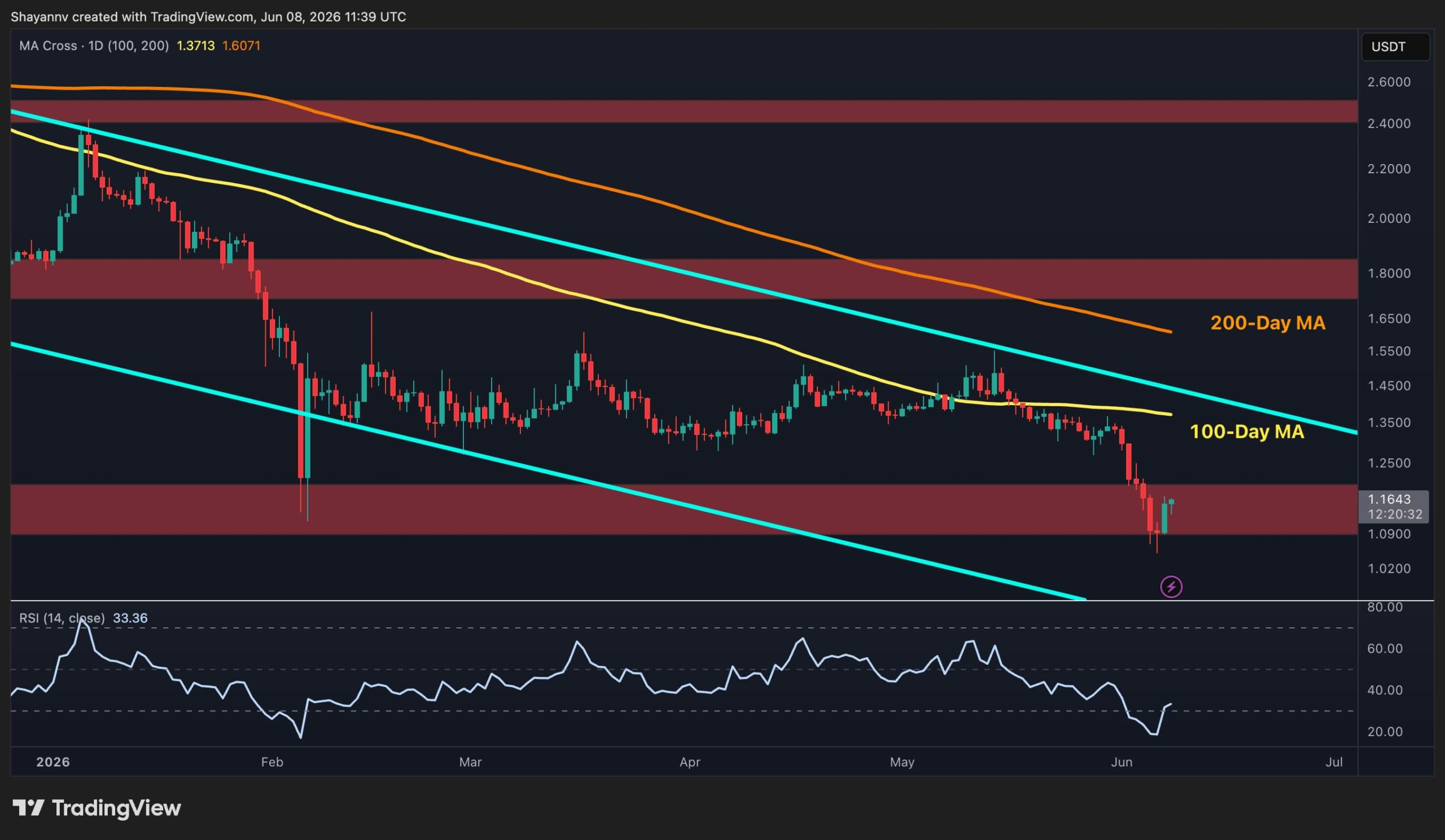
    On the daily chart, XRP recently breached local support around the $1.30 mark, subsequently falling into a significant demand zone situated between $1.10 and $1.20. This area has historically proven attractive to buyers, and it has once again spurred a reaction, with the price rebounding after a brief dip below the zone’s lower boundary.

    Despite this bounce, the overarching market structure for XRP remains bearish. The cryptocurrency is trading within a long-term descending channel and continues to remain below both the 100-day moving average, approximately at $1.35, and the 200-day moving average, near $1.60. The bearish alignment of these moving averages suggests that sellers are still in control of the higher-timeframe trend.

    For buyers to regain momentum, the immediate challenge is to reclaim the 100-day moving average and establish the $1.35-$1.40 region as support. A successful recovery above this area could pave the way for a move towards the next major resistance zone around $1.80. Conversely, a failure to hold the current support could expose the lower boundary of the descending channel, potentially triggering another downward leg. Meanwhile, the Relative Strength Index (RSI) has recovered from near-oversold conditions and is currently hovering around 33, indicating a slight easing of bearish momentum, though a strong bullish reversal signal has yet to emerge.

    XRP vs. Bitcoin Performance

    Against Bitcoin, XRP is exhibiting more constructive price action following several months of underperformance. The XRP/BTC pair recently found support near 1,700 satoshis and has since printed a series of higher lows, suggesting that selling pressure may be waning.

    The pair is currently trading around the 1,820 satoshi region, which coincides with an important resistance area and sits just below the declining 100-day moving average. A decisive breakout above this zone could bolster the recovery narrative and allow XRP to target the next resistance area around 2,000 satoshis, where the 200-day moving average is also located.

    However, the broader trend for the XRP/BTC pair remains negative, as it continues to trade within a long-term descending channel and remains below both the 100-day and 200-day moving averages. Consequently, any sustained bullish continuation will likely necessitate a firm break above the 1,850 satoshi resistance cluster.

    Furthermore, the RSI for the BTC pair has shown notable improvement, hovering near the neutral 55 level, which reflects strengthening momentum compared to XRP’s performance against USDT. As long as XRP maintains its position above the 1,700 satoshi support, the probability of an extension towards higher resistance levels remains elevated. Nevertheless, a breakdown below this floor would invalidate the recent recovery structure and shift the focus towards the lower channel support near 1,500 satoshis.