Tag: Neutral

  • Cardano Price Plunge to $0.10 Possible, Founder Warns

    Cardano Price Plunge to $0.10 Possible, Founder Warns

    The cryptocurrency market has experienced significant selling pressure over the past week, with Cardano’s price among the hardest hit of major digital assets. Data from CoinGecko indicates that the altcoin has shed over 30% of its value in the last seven days. However, one crypto founder suggests that panic-selling Cardano during this period of capitulation may not be the most prudent strategy.

    Potential Accumulation Zone Identified for ADA

    In a post on the social media platform X on June 5th, Joao Wedson, founder and CEO of Alphractal, outlined key price levels to monitor should the worst-case scenario materialize for Cardano. The on-chain data expert identified $0.1097 and $0.03478 as critical thresholds if the current price correction persists.

    Wedson explained that these levels represent Cardano’s “Thermo Price” and “Delta Price,” respectively. The Thermo Price, described as a more stable metric, is calculated by dividing the blockchain’s historical revenue (in USD) by its current circulating supply. Wedson characterized this on-chain valuation metric as the “price per coin,” reflecting the accumulated historical cost or revenue generated from issuance and validator fees throughout the blockchain’s existence. He elaborated, “It is an on-chain valuation metric, similar to a historical cost of production or network security diluted by circulating supply.”

    The Delta Price, on the other hand, measures the difference between the Realized Price and the Thermo Price. This metric aims to connect investors’ average cost basis with the mining or production costs of validators, offering insights into potential deep-cycle bottoms and long-term accumulation regions.

    Wedson noted that Cardano’s price has only reached the Delta Price on two occasions and has never touched the Thermo Price. “I am not saying the price will necessarily visit these levels, but these are regions that need to be monitored closely, since the values change frequently, especially the Delta Price,” he clarified.

    The Alphractal CEO further suggested that the $0.05 to $0.10 range could present a compelling accumulation zone for ADA, particularly if additional bearish pressure emerges. Nevertheless, Wedson also posited that if the cryptocurrency’s price stabilizes, investors might consider waiting a few months to acquire Cardano at higher levels, with greater confidence, after a retest.

    Cardano Price Overview

    As of this report, ADA is trading around $0.1568, marking a 16% decrease in the past 24 hours.

  • XRP RSI Hits Record Low Amid Market Watch

    XRP RSI Hits Record Low Amid Market Watch

    XRP’s Monthly Relative Strength Index Hits All-Time Low, Signaling Potential Oversold Conditions

    The XRP monthly relative strength index (RSI) has plunged to 41.64, marking the lowest reading this indicator has ever registered for the cryptocurrency. This figure dips below the previous low of 43.75, recorded in March 2020, a period when XRP bottomed out at $0.11 amidst one of the crypto market’s most severe downturns.

    A Signal With A Caveat

    While the current reading surpasses the 2020 low, it is not yet definitive. The month of June remains open, and data indicates that if XRP manages to recover to above $1.30 before the month concludes, the RSI could finish significantly higher than its current level, thereby diminishing the importance of this signal.

    Austin, a commentator within the XRP community who uses that moniker, was the first to publicly highlight the RSI’s decline. His initial chart indicated a drop to 42.64, which at the time was a new all-time low, as XRP slid to $1.18. Prices have since fallen further, pushing the RSI down to 41.62 at the latest check. The token is currently trading around $1.11, approximately 61% below its October 2025 peak of $2.84. This decline has persisted for several months without a substantial recovery.

    What History Suggests

    The 2020 episode provides a point of comparison, though it is a singular instance. The RSI bottom in that year coincided with what proved to be XRP’s price floor for that cycle. From that low, the token subsequently posted a series of higher lows, eventually reaching $1.96 in April 2021. A subsequent surge in November 2024 propelled it to a high of $3.40, representing a gain of roughly 580% from the October lows of that year.

    The broader cryptocurrency market has also experienced pressure this week. Bitcoin saw a decline towards the $63,000 mark after MicroStrategy, the firm associated with Michael Saylor, confirmed the sale of 32 BTC from its holdings exceeding 800,000 BTC. The total cryptocurrency market capitalization shed $330 billion over the past week.

    XRP’s Own Decline In Focus

    XRP’s market capitalization fell from $82.5 billion at the beginning of this week to approximately $69 billion at the time of writing, a decrease of roughly 15%. Reports indicate that the current price of $1.10 revisits levels last observed in early February.

    The RSI measures the speed and magnitude of recent price changes. A reading below 30 is traditionally considered oversold territory. XRP’s monthly reading of 41.64 remains above this threshold, though it represents a historically low level specifically for the token. The ultimate significance of this signal will depend on where the June candle closes in relation to its current RSI reading.

  • Dogecoin Tests Support: Breakdown or Rebound?

    Dogecoin Tests Support: Breakdown or Rebound?

    Dogecoin Nears Key Support as Market Declines

    Cryptocurrency analyst Ali Martinez has observed that Dogecoin has returned to a critical support level within a parallel channel following a recent market downturn.

    Dogecoin’s Parallel Channel Trajectory

    In a recent post on X, formerly Twitter, Martinez detailed Dogecoin’s current trading position relative to a parallel channel. This technical analysis pattern occurs when an asset’s price moves between two parallel trendlines. The upper trendline typically acts as resistance, while the lower trendline offers support, effectively confining the price within the channel. A breach of either level can signal a continuation of the trend in the direction of the breakout. An upward surge above the pattern suggests bullish momentum, whereas a fall below it indicates bearish sentiment.

    Parallel channels can be categorized by their orientation. An “ascending channel” features upward-sloping trendlines, while a “descending channel” has a downward slope. The pattern of most relevance here is a parallel channel that runs horizontally, parallel to the time axis, signifying a period of consolidation.

    Martinez shared a chart illustrating the parallel channel within which Dogecoin’s daily price has been trading for the past few months. The graph shows Dogecoin retesting the upper boundary of the channel in May but encountering resistance. Subsequently, the memecoin experienced a sharp decline, moving down the width of the channel to reach its lower level. During this descent, Dogecoin not only fell below the midway support but also lost its 50-day moving average.

    With Dogecoin now retesting the channel’s lowest trendline, its future trajectory remains uncertain. “As long as this support holds, I think a recovery toward $0.1019 and $0.1156 remains likely,” Martinez stated. “A breakdown, however, could expose the next major supply zone near $0.067.”

    Cardano’s Divergent Path

    While Dogecoin has yet to break out of its parallel channel, another altcoin, Cardano, has experienced a different outcome. Martinez highlighted in a separate X post that the weekly price of Cardano (ADA) recently fell below the support level of a long-term channel.

    Breakouts from parallel channels are often projected to be of a length equivalent to the channel’s width. Based on this principle, Martinez projected targets for Cardano: “$0.11 and $0.051.”

    Following the latest market drawdown, Dogecoin’s price has reached the $0.843 level.

  • Ripple IPO: Expert Forecasts Public Listing Timeline for XRP Investors

    Ripple IPO: Expert Forecasts Public Listing Timeline for XRP Investors

    SBI Holdings CEO Suggests Ripple IPO Could Be a Decade Away

    The prospect of Ripple Labs going public has resurfaced in discussions, fueled by SBI Holdings CEO Yoshitaka Kitao, who has provided one of the most concrete long-term timelines yet from a significant Ripple shareholder. Kitao, the chief executive and president of SBI, a major Japanese financial conglomerate, made remarks that have since garnered attention within the XRP community.

    Discussing his long-term investment strategy, Kitao indicated a willingness to invest between $626 million and $1.25 billion in Ripple upon its public debut.

    SBI Chief Believes Ripple Needs to Go Public

    The question of whether Ripple Labs will eventually list on a public exchange has been a persistent one for years, despite consistent efforts by Ripple executives to temper expectations regarding an Initial Public Offering (IPO).

    Speaking at a recent conference in Tokyo, Kitao stated his intention to make a substantial investment in Ripple when the company becomes publicly traded. He suggested that Ripple would be prepared to commit ¥100 billion, or even ¥200 billion, to fully realize its objectives.

    Intriguingly, the SBI Holdings CEO also projected that Ripple might go public in approximately 12 years, emphasizing his belief that such a move is necessary for the company. This timeline places a potential listing around 2038, well beyond the current economic cycle.

    Kitao’s comments carry weight because he is not merely an outside observer or an XRP commentator speculating on price catalysts. SBI Holdings has been a steadfast supporter of Ripple since 2016, investing in the company and co-founding SBI Ripple Asia, a joint venture aimed at leveraging Ripple’s technology for cross-border payments in Asia. SBI has publicly disclosed its ownership of approximately 9% of Ripple Labs, positioning it as one of the company’s largest external shareholders.

    Company Has Consistently Downplayed IPO Talk

    Speculation about a Ripple IPO has circulated for years, particularly following the conclusion of its legal dispute with the U.S. Securities and Exchange Commission in 2025. During this period, Ripple has also expanded its operations into areas such as custody services, stablecoin infrastructure, real-world asset tokenization, and strategic acquisitions.

    However, Ripple executives have consistently maintained that the company is not in a hurry to pursue an IPO. For instance, Ripple CEO Brad Garlinghouse dismissed IPO discussions last year, stating that the company did not require external funding.

    In January 2026, Ripple President Monica Long reiterated that the company intended to remain private, citing its strong balance sheet as sufficient to support continued growth without the need to raise capital from public markets. This stance aligns with Ripple’s recent success in private funding rounds, having raised $500 million at a valuation of approximately $40 billion in late 2025.

  • XRP Faces Potential 40% Plunge to $0.70

    XRP Faces Potential 40% Plunge to $0.70

    XRP Faces Steep Decline, Analysts Divided on Future Trajectory

    XRP’s value has plummeted, concluding a 22% retracement over the past month and falling below $1.10 for the first time since November 2024. This sharp downturn has ignited a critical question among investors: will the altcoin recover to the $1 mark soon, or is a further decline imminent?

    Bearish Technical Indicators Signal Caution

    Market expert Sam Daodu has highlighted a broadly bearish technical outlook for XRP across multiple timeframes. The token is currently trading below its 20, 50, 100, and 200-day moving averages, a configuration that typically indicates sustained seller dominance. Daodu noted that support is minimal once XRP trades at $1.09, with buyers historically showing interest around $1.05 and the $1 level serving as a significant psychological floor.

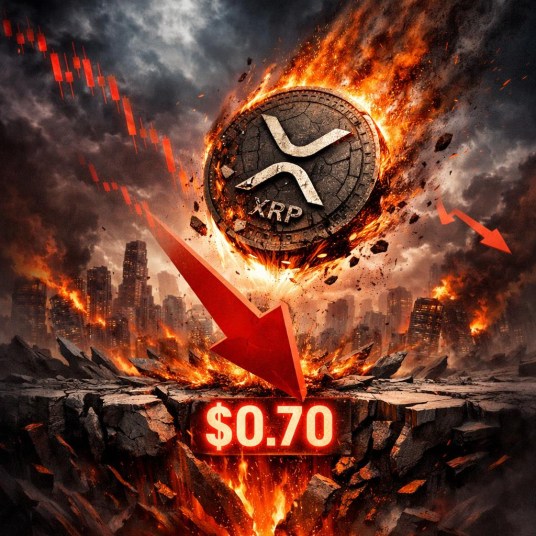
    Adding to the concerns, some chart analysts referenced in Daodu’s report suggest that if the current risk-off trend persists, XRP could experience an additional 40% drop, bringing its price down to approximately $0.70.

    On-Chain Data Paints a Contrasting Picture

    Despite the bearish technical signals, on-chain data presents a more optimistic narrative. The number of XRP wallets holding at least 10,000 tokens reached a record high of 332,230 in May and has continued to grow throughout the recent downturns. Furthermore, wallets holding one million or more XRP have seen a net increase of 42 new addresses since January, marking the first growth in “millionaire” wallets since September 2025.

    Whale activity also suggests a tightening of supply. Holders of 10 million or more XRP now control 45.83 billion tokens, representing 68.5% of the circulating supply – the highest concentration observed since May 2018. Additionally, whale outflow dominance on Binance recently surged to 91.4%, a level not seen since 2024. Historical data indicates that when Binance outflow dominance last reached similar peaks in October 2024, XRP subsequently rallied from around $0.50 to over $3 in the following months.

    A longer-cycle technical indicator also offers a glimmer of hope. XRP’s monthly Relative Strength Index (RSI) has entered the oversold reset zone for only the fourth time in 13 years. Each previous instance of this RSI reset preceded a significant reversal in XRP’s price direction, and Daodu suggests this fourth occurrence is now forming as XRP hovers around $1.09.

    Policy and Market Dynamics as Potential Catalysts

    While whale accumulation and long-term technical signals point towards a potential rebound, near-term catalysts are largely expected to stem from policy developments. Daodu identifies the CLARITY Act’s floor vote as a potential turning point for XRP’s outlook. The bill has advanced through the Senate Banking Committee and is now on the Senate Legislative Calendar, with a full Senate floor vote being the next crucial step.

    Standard Chartered has forecast that if the CLARITY Act is passed and the broader macroeconomic environment stabilizes, XRP could reach $2.80, with a bullish scenario projecting a rise to $8. Conversely, if the bill is delayed beyond the current legislative session, the bank suggests prices could retreat to around $0.53.

    Regarding the possibility of XRP falling below $1, Daodu’s assessment is conditional. He anticipates that the altcoin may test the $1 level before the current sell-off concludes, with the outcome dependent on two key factors.

    Firstly, the ability of Bitcoin (BTC) to reclaim and hold above $60,000 is critical. Daodu suggests that a slide in BTC towards $55,000 would likely drag XRP down, irrespective of its own fundamentals.

    Secondly, the CLARITY Act must receive a Senate floor vote before the August recess. If this vote occurs and the bill is approved, it could create sufficient upside potential to attract institutional investment, potentially triggering a rally from the downturn’s low point.

  • Lawmaker: Government Stablecoins Risk Fueling Tax Evasion

    Lawmaker: Government Stablecoins Risk Fueling Tax Evasion

    Sherman Slams Stablecoin Payments as Tax Evasion Tool

    Longtime cryptocurrency critic U.S. Representative Brad Sherman (D-CA-32) voiced strong opposition to government stablecoin payments during a House hearing on banking regulators Thursday, asserting that such a system would facilitate tax evasion.

    During the hearing, titled “Oversight of Prudential Regulators,” National Credit Union Administration Chairman Kyle Hauptman presented the idea of the federal government distributing funds via stablecoins. He highlighted that stablecoins operate around the clock, unlike traditional payment systems constrained by business hours. Hauptman suggested this could allow for tax refunds to be issued on Sundays or holidays and emergency stimulus payments to be delivered more swiftly and securely.

    Sherman, however, countered that he “can’t think of a worse idea,” arguing that government payments in stablecoins would “sanctify an alternative to the U.S. dollar, an alternative designed to facilitate a tax-evasion economy.”

    Hauptman defended dollar-pegged tokens as a means to counter rivals in Beijing, Tehran, and Moscow and to preserve the dollar’s global standing by stimulating demand for U.S. Treasuries.

    The issue of stablecoin yields also arose, with Sherman warning that “the smartest, or at least the best-paid lawyers in the country” were already seeking loopholes around interest payments on stablecoins. He urged supervisors to “write regulations that withstand that.”

    World Liberty Financial Charter Application Sparks Confrontation

    The hearing also featured Comptroller of the Currency Jonathan Gould defending his agency’s handling of the national trust-bank charter application from World Liberty Financial, a firm linked to the Trump family.

    The House Financial Services Committee hearing became contentious when Representative Gregory Meeks (D-NY-5) directly questioned Gould’s independence, asking if he was “working for the American people or working for the Trump family.”

    Gould pushed back, labeling Meeks’ remarks as “unfortunate and without precedent.” He added, “Your attempts to continue to pressure me are the only political pressure I’ve felt from anyone other than your Senate colleagues.”

    Regulators Outline Stablecoin Oversight Progress

    Beyond the World Liberty Financial issue, federal regulators provided updates on their progress in overseeing stablecoins under the GENIUS Act, passed last summer. FDIC Chairman Travis Hill stated that his agency, along with others, would soon propose customer identification requirements for stablecoin issuers.

    These regulatory developments coincide with increased access for cryptocurrency firms to traditional banking infrastructure. Falcon Financial launched its fUSD stablecoin on Wednesday, utilizing Anchorage Digital—the first federally chartered crypto bank—as a GENIUS-compliant payments token. The Federal Reserve has also granted cryptocurrency exchange Kraken a master account, though with certain limitations, similar to the “skinny” master account proposed by the Fed’s board of governors last year.

    World Liberty Financial claimed last month to be in the “final stages” of receiving conditional approval, asserting that the Trump sons have not abandoned the project despite regulatory hurdles.

    Banking charter approvals for crypto firms have become a politically charged issue. Senator Elizabeth Warren (D-MA) has deemed approvals for firms like Coinbase and Ripple as illegal. Meanwhile, the Trump White House had previously directed the Federal Reserve to review master account access for crypto firms and instructed federal regulators to remove “overly burdensome and fragmented regulations and supervisory practices.”

  • XRP Sentiment Sours: Divine Ray ICO’s Live Product Outshines Waiting

    XRP Price Faces Stagnation Amidst Institutional Accumulation and Shifting Crowd Sentiment

    XRP’s price saw a 3% dip last week, now trading within the $1.30 to $1.40 range, a situation that has proven frustrating for many holders. However, beneath the surface of this price stagnation, significant activity is unfolding. Institutions are reportedly making daily purchases, and Exchange Traded Fund (ETF) inflows continue to pour in. Concurrently, crowd sentiment has once again turned sharply negative.

    Divine Ray ICO Surpasses $100,000 on Launch Day

    In contrast, a cryptocurrency presale known as Divine Ray ($DCR) has achieved a notable milestone, raising over $100,000 on its opening day. Divine Ray distinguishes itself with a live social media application and its own proprietary blockchain.

    While XRP holders await a delayed breakout, Divine Ray presents a functional product and a $5 million valuation, a combination that analysts suggest is compelling.

    Analyst Predicts Bold XRP Targets Amidst Accumulation

    Crypto analyst Patel recently shared an updated XRP chart on a four-day timeframe. The analysis places XRP’s current trading price at $1.3607, situated firmly within a multi-year accumulation zone that spans roughly from $0.50 to $1.80.

    Patel has outlined ambitious long-term price targets for XRP, indicating potential upside levels of $5, $10, and even $15 per token. He attributes this optimistic outlook to sustained institutional buying, noting that these entities are not selling but are instead quietly increasing their holdings daily.

    Data supports this observation, with total net ETF inflows for XRP reaching $1.41 billion since their inception. Over the past 15 trading days alone, there have been $116.48 million in direct inflows. Outflow days have been infrequent, occurring on only 13 out of 193 days, meaning over 90% of trading days have seen net inflows. This suggests substantial capital accumulation by large investors while retail interest appears subdued. Patel characterizes this period as “the calm before the storm,” advising potential buyers to consider accumulating during significant market downturns within the $1 to $0.70 range.

    Crowd Sentiment Dips into “FUD Zone”

    Santiment’s latest data on XRP crowd sentiment reveals a significant shift, with the ratio of positive to negative commentary dropping to a mere 1.1 bullish comments for every bearish comment. This marks the highest level of crowd fear, uncertainty, and doubt (FUD) observed in three weeks. The sentiment ratio chart indicates a sharp decline into the “FUD Zone,” a region historically associated with price stabilization and subsequent bounces, as seen in late April and early May.

    Historically, such widespread fear and skepticism have served as a contrarian indicator for XRP’s price. When social media sentiment becomes excessively fearful, it often signifies that many less committed investors have already exited the market, thereby reducing selling pressure and creating conditions conducive to a rebound. Conversely, periods of extreme optimism, where the sentiment ratio enters the “FOMO Zone,” have often coincided with local price peaks due to widespread bullish positioning. Currently, the market’s position within the fear zone suggests a potentially opportune time for buying.

    XRP Price Prediction and Divine Ray’s Value Proposition

    Based on this data, an XRP price prediction suggests a potential bounce towards the $1.50 to $1.60 range in the coming weeks. Continued ETF inflows and sustained institutional demand could propel XRP above $1.60, potentially opening the path to $2.00 and beyond. However, even the most optimistic long-term targets of $5 to $15 per XRP, representing a 3x to 10x return over multiple years, are considered respectable but not necessarily life-changing for smaller investment portfolios.

    Divine Ray, on the other hand, offers a tangible product with its fully functional mobile social media application, available on both the Apple App Store and Google Play. This approach, launching a product before its token, is a rarity in the cryptocurrency space. Users can download the app, create an account, and begin using it immediately.

    The project is built on its own blockchain infrastructure, developed using the Cosmos SDK and integrated with the IBC network, granting Divine Ray complete control over its technology, scalability, and future ecosystem development. Divine Ray Coin ($DCR) is already trading on the Osmosis decentralized exchange, providing immediate liquidity and market validation from the presale’s inception.

    Divine Ray targets the expanding global consciousness and wellness economy, a sector encompassing meditation, yoga, retreats, spiritual content, and conscious communities. The platform aims to connect creators, retreat centers, events, and communities within a unified ecosystem. The $DCR token possesses multiple utilities, including memberships, advertising, NFT minting, creator rewards, and community growth incentives, each contributing to demand drivers within the platform’s social economy.

    The project’s initial valuation of approximately $5 million during Phase 1 of its ICO is considered exceptionally low compared to industry norms, where many projects launch with websites alone at valuations of $50 million or $100 million. Divine Ray’s existing live app, functional blockchain, and DEX listing present a significant valuation gap, offering potential for substantial returns.

    The $DCR presale is structured in four phases, with prices increasing incrementally. Phase 1 offers 400 billion DRC at $0.0000015 per token, with subsequent phases moving to $0.000002, $0.0000025, and $0.0000035. Phase 1 remains open, but its momentum, evidenced by exceeding $100,000 on day one, suggests it may not last. Divine Ray is positioned as a presale to watch this summer.

  • XRP Faces Critical Juncture: ‘Wick or Brick’ to Dictate Macro Trend

    XRP Faces Critical Juncture: ‘Wick or Brick’ to Dictate Macro Trend

    Crypto Markets Plunge, XRP Faces Critical Juncture

    Cryptocurrency markets have once again experienced significant turmoil, with Bitcoin falling to $61,000 this morning, a level not seen in four months. While some altcoins initially resisted the downturn, they have since followed suit, registering even steeper losses.

    Ripple’s XRP has not been spared. The digital asset, which traded above $1.55 just weeks ago, has seen a sharp decline following a rejection at higher levels. XRP plunged to just under $1.10 today, marking its lowest price point since before the U.S. presidential elections in late 2024.

    Analyst Foresees Potential for XRP’s Next Major Cycle

    Despite the current short-term volatility, a prominent analyst known as EGRAG CRYPTO has offered a broader perspective, suggesting that the current market movements could be the prelude to a significant shift.

    EGRAG CRYPTO pointed out that XRP is approaching a critical juncture that could determine its next major cycle. Drawing a parallel to early 2017, the analyst highlighted a historical pattern where XRP briefly dipped below a key structural support level, termed the “Bifrost Bridge,” before embarking on a substantial upward trend.

    This previous bull phase, EGRAG explained, was initiated by a sharp downside wick designed to purge less committed investors and reconfigure market positions.

    ‘Wick or Brick’ Scenario for XRP’s Future

    The analyst posed a crucial question: “Will we get another massive liquidity wick… or will price build a solid brick structure above support?”

    EGRAG CRYPTO predicted that a deep wick scenario could lead to a significant shakeout of weak hands, foster widespread fear, rapidly sweep liquidity, and establish a final macro reset. This aggressive downward move would challenge the broader market’s current positioning.

    Alternatively, EGRAG’s analysis presents a “brick” structure scenario. In this case, XRP would consolidate above key support levels, such as $1.00 and $1.10, gradually building a stable foundation. This outcome would indicate stronger accumulation and increased market confidence, potentially paving the way for an earlier upward continuation without the need for a dramatic price flush.

    Analyst Leans Towards a Final Emotional Move

    While acknowledging the prevailing uncertainty, EGRAG CRYPTO expressed a personal inclination towards the former scenario.

    “Personally…I still think the market wants one final emotional move before the real expansion,” the analyst concluded.

  • ZCash Exploit Discovered, Scale Uncertain

    ZCash Exploit Discovered, Scale Uncertain

    Zcash Exploit Discovered by White-Hat Hacker Using Advanced AI

    A critical vulnerability in Zcash’s privacy-focused Orchard pool, which could have allowed for the minting of unlimited counterfeit ZEC, was discovered by security researcher Taylor Hornby. The exploit, which had been present for approximately four years, was identified using Anthropic’s Claude Opus 4.8 AI model. The Zcash ecosystem deployed an emergency fix on June 1, addressing the issue.

    The Nature of the Vulnerability

    The Orchard pool, Zcash’s most advanced shielded transaction layer launched in May 2022, utilizes zero-knowledge proofs to validate transactions without revealing sender, receiver, or transaction amounts. The flaw lay in a specific validation check for transaction inputs, which failed to enforce the intended rules. This allowed an attacker to submit false inputs that would still pass the validation, enabling the creation of ZEC out of thin air, with the zero-knowledge proof system erroneously marking the fraudulent transactions as legitimate.

    Hornby, working with Claude Opus 4.8, successfully developed a functional exploit that could generate unlimited, undetectable counterfeit ZEC. He promptly disclosed his findings to ZODL, Zcash’s development coordination body, instead of exploiting the vulnerability on the mainnet.

    Undetermined Impact Due to Privacy Features

    The very privacy features that make the Orchard pool valuable also render it impossible to cryptographically determine if the vulnerability was exploited between May 2022 and June 2026. The Zcash team, which hired Hornby, has stated that exploitation prior to the fix is unlikely. They cited the bug’s evasion of years of scrutiny from expert cryptographers, the necessity of cutting-edge AI tools for its discovery, and a narrow window for remediation. However, they cautioned that users should not solely rely on their assessment.

    Future Network Upgrades and Security Initiatives

    Shielded Labs is proposing a network upgrade that would introduce a new shielded pool and implement “turnstile accounting” for all existing Orchard pool coins. This mechanism would require every Orchard coin to pass through a verifiable checkpoint, thereby exposing any counterfeited supply. This proposal requires broad community governance support and will undergo the standard Zcash network upgrade process. A detailed proposal is anticipated next week.

    Furthermore, Shielded Labs is initiating a project to mathematically verify the entire Orchard circuit from the ground up. The organization is also actively recruiting for a Head of Security and a Cryptographer.

    Broader Implications for the Crypto Space

    This incident serves as a significant real-world demonstration of the capabilities of advanced AI models like Anthropic’s Claude Opus 4.8 when wielded by expert security researchers. Hornby discovered the four-year-old critical bug within 24 hours of Opus 4.8’s public release on May 28, a flaw that had previously withstood multiple rounds of expert human review.

    The discovery highlights the increasing importance of AI in cybersecurity and serves as a stark warning to all cryptocurrency protocols. The industry is urged to proactively engage white-hat hackers to test their own protocols for vulnerabilities, rather than risk exploitation by malicious actors. The evolving landscape suggests that the near-term stability of the broader crypto space may hinge on these proactive security measures.

  • Pump.fun’s Latest Experiment Takes Strange Turn

    Pump.fun’s Latest Experiment Takes Strange Turn

    Pump.fun Launches “GO” Platform, Offering Cash for Nearly Any Task

    The Solana meme coin launchpad Pump.fun has unveiled a new platform called GO, designed to pay users for completing a wide range of tasks, from the mundane to the extreme. The initiative, built on the slogan “Pay ANYONE to do ANYTHING,” has already seen a surge of users posting and attempting unusual challenges.

    A Global Bounty Board

    Launched on Thursday, GO allows users to create and complete bounties for any task, with the promise of “unlimited rewards.” Pump.fun stated in a tweet, “Humans & money are undeniably the most powerful tools on Earth. We’re combining both of them with GO: an all encompassing bounty platform where ANYONE can create or complete bounties for ANY task for UNLIMITED rewards.”

    Users connect their X (formerly Twitter) accounts and cryptocurrency wallets to the platform. They can then post a task and lock in rewards, starting at $5, which are held in escrow. Pump.fun reviews submissions and handles payouts.

    As of this report, GO listed 234 active bounties, with 494 submissions and an unclaimed pool of $118,000.

    High-Stakes and Bizarre Challenges

    The platform has featured some exceptionally high-paying, albeit often outlandish, bounties. One notable listing, which has since disappeared, offered approximately $2,650 for someone to get a token’s ticker tattooed on their forehead. Earlier, a bounty of up to $50,000 was advertised for a skydiver to land in a World Cup match dressed as a meme coin mascot, with strict requirements for verified, non-AI footage.

    The highest remaining bounty at the time of writing was worth roughly $23,525, seeking an interview with a family member of the individual responsible for Henry Nowak’s death or the lead police officer on the case. The listing emphasized the desire for at least two minutes of unedited footage and noted that “the more viral the interview the better.”

    Other significant bounties included $15,204 for breaking a running world record, $12,199 for organizing a “NEET March” in New York City, $11,034 to assist a token in winning Pump.fun’s hackathon, $3,989 for a “best butt contest,” and $9,103 for an interview with a billionaire on biological intelligence.

    Risky and Unconventional Tasks

    Further down the list, tasks become increasingly strange and, in some cases, dangerous. Bounties have included requests to set a branded car on fire, streak an NBA Finals game, fart through a megaphone during a lecture, pour milk over oneself, distribute 100 jars of pineapple Kool-Aid to homeless individuals, get Elon Musk to engage with a token on X, and bail someone out of jail.

    One participant in a bounty offering approximately $2,876 for quitting a job on camera livestreamed the event on Kick. The individual reported being fired from another job as a result, stating, “This was worth it for the sol.”

    Financial Realities and Concerns

    Despite the large advertised sums, actual payouts have been modest. The top earner since the launch collected $487.11 in a single payout, with other significant payouts reaching $346.72 and $275.49. The largest spender on the platform has disbursed $1,707 across 11 bounties.

    Musheer Ahmed, founder and managing director of Finstep Asia, expressed concerns about the platform’s escrow and moderation system, suggesting it might not be sufficient to prevent harmful bounties. He noted that automated moderation systems have historically struggled on platforms like Instagram and X, and that creators can circumvent these by coordinating with users off-platform.

    “It feels like it is an attempt by pump.fun to retain users/attract non-crypto native users,” Ahmed commented, drawing parallels to task-based content creators like MrBeast. He added that the initiative appears to have little to do with “tokens, NFTs, and crypto in general.”

    GO formalizes a pay-for-stunts incentive that has previously led to dangerous situations on Pump.fun. The launchpad had previously removed its livestreaming feature in 2024 following an influx of controversial streams involving animal cruelty, self-harm, and a faked suicide. Pump.fun reinstated livestreaming in early 2025 with enhanced moderation and has since focused on “creator capital markets,” linking viral stunts with tradable tokens.

    Pump.fun did not respond to a request for comment.