Tag: Neutral

  • Grayscale in Talks for 200,000 ZEC Contribution to Zcash Trust

    Grayscale in Talks for 200,000 ZEC Contribution to Zcash Trust

    Grayscale in Talks for Significant Zcash Contribution as Trust Eyes NYSE Arca Listing

    Grayscale has revealed ongoing discussions with a subsidiary of Digital Currency Group (DCG) concerning a potential contribution of approximately 200,000 ZEC to its Zcash Trust. This development, disclosed in an August 18 amendment to a registration statement, signals a move to list the trust on the NYSE Arca.

    Grayscale Investments Sponsors, the entity overseeing the trust, stated it is in talks with DCG International Investments Ltd. for the subsidiary to acquire shares via an authorized participant in exchange for the specified tokens. The filing clarifies that “because these discussions are not binding agreements or commitments to purchase, the Potential Investor could determine to purchase more, fewer, or no Shares.”

    The trust also intends to trade under the ticker ZCSH, a symbol already associated with its shares on the OTCQX market. As of June 30, the trust’s net asset value stood at $155.2 million, holding roughly 2.3% of circulating ZEC. On August 12, its shares closed at $36.6, representing a 7% discount to the net asset value per share.

    Since October 2021, the trust’s shares have traded at a discount for 700 days, with a maximum discount reaching 55% and a peak premium of 240%. The Securities and Exchange Commission (SEC) has yet to approve or disapprove these shares.

    Should the proposed contribution proceed, Grayscale’s parent company would assume a controlling stake. The filing indicates that DCG “may, directly and indirectly through the Potential Investor and other affiliates, own a majority of the Shares representing ownership in the Trust,” thereby holding “the ability to control the outcome of virtually all matters presented to our shareholders for their approval.”

    DCG is also actively involved in mining the asset. Its subsidiary, Fortitude Mining, mines ZEC and manages network infrastructure. Furthermore, Foundry Digital operates a ZEC mining pool that accounted for approximately 15.4% of the Zcash Network’s hash rate for the month ending July 2026.

    The filing warns that DCG “could prioritize its own interests in these and other investments over those of the Trust.” This comes as Zcash recently implemented the Ironwood upgrade and its turnstile mechanism following the discovery of a counterfeiting bug in the Orchard shielded pool.

    The Sponsor’s Fee, identified as the trust’s sole anticipated ordinary recurring expense, is noted in Amendment No. 4 with its annual rate left unspecified, similar to the trust’s intended new name. Coinbase Custody Trust Company currently holds the ZEC, with Coinbase acting as the prime broker.

    Grayscale has previously navigated similar conversions. The SEC previously approved its Digital Large Cap Fund for NYSE Arca listing under generic listing standards that eliminated the need for a 19(b) filing. The asset manager had also previously filed to convert its XRP trust into an ETF on the same exchange.

    As of August 19, ZEC was trading at $550.78, with a market capitalization of $9.3 billion, according to CoinGecko.


  • AI Predicts XRP Growth Potential by 2030

    AI Predicts XRP Growth Potential by 2030

    AI and Analysts Offer Divergent XRP Price Predictions for 2030

    Artificial intelligence and financial analysts are presenting a wide spectrum of potential values for XRP by the end of 2030, with the ultimate outcome hinging on crucial factors like regulatory clarity and the adoption of Ripple’s products.

    An investment of $1,000 in XRP at $1.07 would yield approximately 935 tokens. AI chatbot Claude AI projects that these tokens could be worth anywhere from $4,675 to $26,180 by 2030. This broad range underscores the significant impact of underlying assumptions on the final prediction.

    Standard Chartered’s Bullish Outlook Tied to Regulatory and ETF Factors

    Geoffrey Kendrick of Standard Chartered has put forth what is described as a “bank-grade roadmap,” forecasting XRP prices of $7 in 2027, $12.60 in 2028, and $28 by 2030. However, this optimistic scenario is contingent on two key conditions: the passage of the CLARITY Act and spot ETF inflows exceeding $4 billion.

    Current inflows stand at approximately $1 billion since November 2025, indicating a fourfold gap between existing flows and the level required by Kendrick’s model.

    Bitwise’s Similar Projections and Downside Risks

    Bitwise arrives at a comparable conclusion through a similar analytical path. Its most optimistic model forecasts a price of $29.32, which includes a speculative allocation for a U.S. strategic XRP reserve. Claude, meanwhile, does not treat downside scenarios as hypothetical. Bitwise’s own bear case predicts a price of $0.13, which would reduce the initial $1,000 investment to roughly $122.

    Structural Concerns and the Rise of RLUSD

    A more immediate structural concern is the increasing institutional volume on the network being captured by Ripple’s RLUSD stablecoin, rather than XRP itself. This dynamic leads several analysts to consider price targets between $8 and $12 as more realistic than the higher projections. While utility is emerging, it may not be directly benefiting the XRP token.

    Recent Price Action and Technical Indicators

    The recent daily chart activity offers context for why lower price predictions warrant attention. XRP traded near $2.65 last October and experienced a ten-month decline. In February, the price broke below the $1.80 level, pushing it towards $1.15. The spring saw a trading range between $1.30 and $1.55, which persisted into May.

    June saw this range broken, and the downward trend continued through the summer, with the price touching $0.995 before the latest trading session. This recent session marked a significant shift, with a sharp reversal lifting XRP back above $1.08 in a single day.

    The closing price was $1.08250, an increase of 8.13%, or $0.08136. The daily trading range spanned from $0.99524 to $1.08261.

    Immediate support levels are identified at $1.00, followed by $0.95 and $0.85. Resistance is anticipated at $1.15, then $1.25 and $1.40. The Relative Strength Index (RSI) stands at 59.05, with its signal line considerably lower at 38.23. This gap of nearly 21 points is unusually wide and reflects a dramatic one-day shift in momentum.

    The oscillator has moved from oversold territory to above the midline, indicating a bullish flip in momentum. However, such rapid price movements rarely sustain without a period of consolidation.

    The Crucial Distinction: XRP Token vs.

    Stablecoin Adoption

    The vast difference between the $122 and $26,180 potential outcomes hinges on whether institutions ultimately utilize the XRP token or the stablecoin. Observing where new volume is directed will be key to determining which end of the predicted range becomes reality.

    XRP’s long-term upside potential is increasingly dependent on whether institutional activity directly benefits XRP itself or is instead absorbed by products like RLUSD.

    LiquidChain’s Approach to Interoperability

    LiquidChain is addressing this challenge from a different perspective. Instead of betting on the success of a single asset within one ecosystem, it is developing infrastructure designed to connect liquidity across several of the largest blockchain networks.

    Currently, Bitcoin, Ethereum, and Solana largely operate as distinct markets. Moving assets between them involves bridges, additional fees, fragmented liquidity, and the need to redevelop applications for each chain.

    LiquidChain is creating a unified execution layer intended to integrate these three major networks. This would allow a single deployment to access multiple ecosystems without incurring repeated cross-chain transaction costs.

    This strategy positions the project to benefit from capital movement itself, irrespective of which large-cap token leads the next market cycle. The presale is currently priced at $0.01454, with over $940,000 raised, leaving substantial room for price adjustments if this infrastructure thesis gains traction.

  • Alibaba Revenue Up 9%, AI Cloud Soars 45%, Profit Plummets

    Alibaba Revenue Up 9%, AI Cloud Soars 45%, Profit Plummets

    Alibaba Reports Strong Revenue Growth Driven by Cloud and AI

    Chinese technology giant Alibaba announced first-quarter revenue of 268.95 billion yuan (approximately $40 billion) on Thursday, marking a 9% increase year-over-year and slightly surpassing analyst expectations of 268.88 billion yuan. This represents the company’s fastest quarterly growth rate in approximately three years, with the surge primarily attributed to its cloud and artificial intelligence businesses.

    Cloud and AI Fueling Expansion

    The company’s cloud division emerged as the primary engine of growth. Alibaba Cloud’s external revenue saw an accelerated expansion of 45%, while revenue from AI-related products reached 12.38 billion yuan ($1.82 billion). This marks the twelfth consecutive quarter of triple-digit year-over-year growth for AI products. CEO Eddie Wu highlighted the improved commercialization of the company’s comprehensive AI strategy as the key driver behind the quarter’s performance, according to Alibaba’s earnings statement.

    However, this aggressive AI push comes at a significant cost. Capital expenditures surged by 75% to 67.7 billion yuan ($10 billion). Alibaba attributed this increase primarily to rising chip prices and the expansion of computing capacity to meet the escalating demand for AI, which is currently outpacing supply. Consequently, free cash flow swung to an outflow exceeding $6.6 billion for the quarter, according to Bloomberg.

    The market’s reaction was swift. Alibaba’s U.S.-listed shares experienced a decline of around 5% shortly after the market opened, though they showed signs of recovery by midday.

    Monetizing AI Through Distribution and Partnerships

    Alibaba’s cloud performance coincides with a strategic shift towards distributing its Qwen models more broadly, moving beyond just their development. Earlier this month, the company released Qwen 3.8-Max, its most advanced model to date, as open weights for the first time at such a large scale. In April, the free tier of its Qwen Code coding agent was discontinued.

    The company is also extending its reach beyond China’s domestic market. Apple is reportedly integrating its in-house AI model with Alibaba’s Qwen to power Apple Intelligence on Chinese iPhones. This potential deal could position Apple as the first foreign company permitted to operate a proprietary AI model within China.

    This focus on distribution and partnerships is beginning to reflect in the data. Chinese open-weight models have seen a dramatic increase in usage, jumping from under 2% of tokens generated on OpenRouter in late 2024 to approximately 61% by mid-2026. This growth has occurred even as Alibaba’s quarterly profit has decreased by three-quarters.

  • Kalshi Market Suggests Lower Odds for October Funding Lapse

    Kalshi Market Suggests Lower Odds for October Funding Lapse

    The market-implied probability of a U.S. federal government funding lapse in October has decreased, with odds on the Kalshi exchange trading between 15 and 16 cents as of August 18. This price suggests an approximate 12% chance of a lapse, indicating a reduction in perceived Washington-related risk.

    With over $193,000 in trading volume, the Kalshi market for government funding lapse odds serves as a live sentiment indicator for macro risk. According to Kalshi, this price offers a snapshot of current market expectations rather than a forecast, and it is subject to change as political developments unfold. The market price may differ when Congress returns from its recess in September.

    Historically, government funding lapses have coincided with tangible economic consequences. For instance, a lapse that began on October 1, 2025, and lasted until November 12, 2025, resulted in the furlough of nonessential federal employees. The Congressional Budget Office projected an $11 billion loss in real GDP by the first quarter of fiscal year 2027 due to that lapse, though this represented less than 1% of GDP. Federal employment saw drops of 162,000 in October and 6,000 in November 2025, with these figures partly attributed to deferred resignations. Key economic data releases were also delayed or canceled during that period.

    Market reactions to past lapses have varied. The S&P 500 rose during the 2025 lapse, and the U.S. dollar, while fluctuating, ultimately strengthened. Federal Reserve Governor Lisa D. Cook noted that while disruptions could slow spending and investment, these effects were expected to be temporary.

    It is important to note the specific definition of the Kalshi contract. It resolves as ‘YES’ only if the federal government is at least partially shut down due to a lapse in appropriations at 10 a.m. ET on October 1, 2026. A lapse beginning on a different date would not trigger a ‘YES’ resolution for this specific contract. This precise definition means the contract price can react to funding talks even before a lapse occurs.

    For traders focused on assets like Bitcoin and Ethereum, the Kalshi contract is best viewed as one indicator of Washington-related uncertainty rather than a direct predictor of price movements. The direct causal link between lapse odds and crypto price action is considered thin. Market participants suggest that any correlation between lapse concerns and broader market sentiment in cryptocurrencies depends more on overall market conditions than on the lapse headline alone. Therefore, the Kalshi price is one input among many for assessing macro risk, not a standalone trading signal.

    Why This Matters

    The materials describe a narrow update: The implied probability of a US federal government shutdown in October, as traded on Kalshi, has decreased to approximately 12% (15-16 cents per contract). The market price can change as appropriations headlines emerge.

    Broader Context

    Source materials place the factual news in this context: Federal government shutdown odds on Kalshi traded at 15-16 cents as of August 18, implying roughly a 12% chance.

  • XRP Reclaims $1 Amid Conflicting Technical Analyses and Unclear Volume Drivers

    XRP Reclaims $1 Amid Conflicting Technical Analyses and Unclear Volume Drivers

    XRP has reclaimed the significant psychological level of $1, trading near $1.15 after an overnight price increase of approximately 15%. However, this price action is currently overshadowed by sharply divergent technical analyses, creating substantial uncertainty regarding XRP’s future trajectory.

    Why This Matters

    The materials describe a narrow update: XRP’s price increased significantly, surpassing the $1 mark. The accuracy and validity of Elliott Wave price targets ($5.8563 and $9.0362).

    Broader Context

    Source materials place the factual news in this context: XRP price climbed roughly +15% overnight to trade near $1.15, reclaiming the psychologically important $1 level after weeks of chop, and XRP analyst Dark Defender argues the move suggests a completed “triple dip” on the weekly chart.

    Divergent Technical Forecasts

    Technical analysts are presenting conflicting outlooks for XRP. According to analyst Dark Defender, the recent price move suggests a completed “triple dip” pattern on the weekly chart, with potential Elliott Wave targets reaching as high as $5.8563 and $9.0362. These targets are considered speculative given their distance from the current price and the thinness of the confirmation. Before such targets could be approached, XRP would need to overcome resistance levels at approximately $1.20–$1.30, $1.50, and $1.88.

    Conversely, other analyses present a more bearish outlook. Just over a week prior, when XRP was trading around $1.01, analyst CasiTrades cited a Relative Strength Index (RSI) reading of 36.62 coupled with a bearish divergence pattern. This suggested a potential for further downside, with projections of a bottom near $0.95, followed by a corrective bounce to $1.00–$1.04, and a final downward leg toward $0.85–$0.86. The critical support level identified in this bearish case is holding above $1; a return below this mark would undermine the bullish premise.

    The core takeaway from these conflicting analyses is the inherent uncertainty. Both interpretations are derived from similar price action data within a two-week window, yet they yield sharply divergent predictions. The ability of XRP to sustain its position above $1 is viewed as a crucial determinant for the validity of either the bullish or bearish scenarios.

    Volume Concentration: Unclear Drivers

    Further complicating the market picture is the observed concentration of XRP trading volume. According to an August 18 disclosure by Evernorth, approximately 23% of all XRP traded on-chain now occurs within a three-hour window encompassing London’s afternoon and New York’s morning. This is a significant increase from about 14% a year ago. This concentration has been noted across various trading venues on the XRP Ledger (XRPL), coinciding with roughly $900 million in RLUSD-XRP volume over the past six months.

    However, the drivers behind this increased volume concentration remain unclear. Public ledger records track transaction timing and volume but do not reveal the identities of the transacting wallets. Evernorth itself has acknowledged that its data cannot suggest whether banks, trading desks, or automated systems are responsible for this shift. Consequently, the narrative of institutional demand underpinning bullish XRP price predictions is considered circumstantial rather than proven.

    In conclusion, while XRP has successfully reclaimed the $1 level, the market faces significant ambiguity. The presence of sharply conflicting technical analyses, coupled with unconfirmed drivers for increased trading volume concentration, means that XRP’s future price direction remains highly speculative and uncertain.

  • ELIZAOS, PRCL, TUSD Delisted

    ELIZAOS, PRCL, TUSD Delisted

    Bybit to Delist Several Tokens, Citing Performance and Compliance Standards

    Cryptocurrency exchange Bybit announced today that it will delist and cease trading for several tokens, including ELIZAOS, PRCL, and TUSD, along with their associated USDT trading pairs. The move, effective August 27, 2026, is part of Bybit’s ongoing commitment to maintaining a secure and reliable trading environment, adhering to its Token Management Rules.

    Delisting Details and Timeline

    The delisting will impact trading on Bybit’s Spot platform, with trading for ELIZAOSUSDT, PRCLUSDT, and TUSDUSDT pairs concluding after August 27, 2026, at 8:00 AM UTC. All open orders for these pairs will be automatically canceled.

    Furthermore, ELIZAOS, PRCL, and TUSD tokens will be removed from Bybit Convert after the same date and time.

    Deposits for these tokens will cease earlier, closing after August 26, 2026, at 8:00 AM UTC.

    Impact on Trading Bots and Withdrawals

    Users employing Spot Grid Bots or DCA Bots on the affected ELIZAOSUSDT, PRCLUSDT, and TUSDUSDT pairs are advised to close their active bots before August 27, 2026, 8:00 AM UTC. Failure to do so will result in automatic termination by the system.

    While withdrawals for ELIZAOS, PRCL, and TUSD assets will remain open after the trading pairs are closed, Bybit recommends users initiate withdrawals promptly to ensure effective asset management.

    The exchange reiterated its dedication to upholding performance and compliance standards through regular reviews of listed tokens and projects.

  • BYDFi to Participate as Gold Sponsor at Coinfest Asia 2026 in Bali

    BYDFi to Participate as Gold Sponsor at Coinfest Asia 2026 in Bali

    BYDFi is set to participate as a Gold Sponsor at Coinfest Asia 2026, an event scheduled for August 20-21, 2026, at Melasti Beach in Bali. This marks the fifth annual edition of the conference, which is geared towards institutions, builders, and traders in the digital asset sector.

    According to the press release, BYDFi intends to use its presence at the event to connect with a broad spectrum of industry stakeholders, including institutional representatives, developers, traders, partners, and community members. The company states its primary objectives are to discuss market access, product usability, and evolving trading needs. BYDFi will host discussions and activities at Booth A1.

    Coinfest Asia 2026 is structured to facilitate dialogue across digital assets, finance, technology, and trading. Its agenda features three main tracks—Institutional, Builders, and Traders—alongside Asia Go-To-Market Sessions designed to provide localized insights into regulatory environments, user behavior, and ecosystem development across key Asian markets.

    Founded in 2020, BYDFi reports a user base exceeding 1,000,000 across more than 190 countries and regions. The exchange is also recognized as the Exclusive Official Crypto Exchange Partner for Newcastle United and was listed by Forbes Advisor Canada among the best crypto exchanges in Canada for 2026. These details underscore BYDFi’s established market presence and industry standing.

    The event’s emphasis on practical product improvement, steady execution, and a dependable trading experience aligns with BYDFi’s stated commitment to providing a world-class crypto trading experience. BYDFi’s participation offers a current perspective on shifts in technology, industry priorities, and user expectations within the cryptocurrency landscape.

    Why This Matters

    The materials describe a narrow update: BYDFi is attending Coinfest Asia 2026 as a Gold Sponsor to connect with institutions, builders, and traders. The event brings together participants across digital assets, finance, technology, and trading.

    Broader Context

    Source materials place the announcement in this context: BYDFi is participating as a Gold Sponsor at Coinfest Asia 2026.

  • XRP Exchange Reserves Decline Amidst Rising On-Chain Activity and Low Social Sentiment

    XRP Exchange Reserves Decline Amidst Rising On-Chain Activity and Low Social Sentiment

    Approximately 240 million XRP has been withdrawn from major cryptocurrency exchanges since early summer, coinciding with an increase in large transactions and network activity on the XRP Ledger. This trend emerges despite a notable decline in social sentiment surrounding the asset.

    Why This Matters

    The materials describe a narrow update: XRP reserves have decreased on major exchanges like Upbit, Binance, and Bithumb. The specific reasons for the XRP withdrawals from exchanges are not detailed.

    Broader Context

    Source materials place the factual news in this context: XRP’s price has been struggling near $1.

    Exchange Reserve Declines

    Data indicates that XRP reserves across prominent exchanges such as Upbit, Binance, and Bithumb have decreased from late May/early June levels to August 19. Specifically, Upbit saw its XRP reserves fall by about 110 million XRP, from 6.51 billion on May 30 to 6.40 billion on August 19. Bithumb experienced a reduction of roughly 30 million XRP, decreasing from 1.85 billion on June 2 to 1.82 billion. Binance reported a drop of approximately 100 million XRP during the same period. Collectively, these three exchanges saw their combined XRP reserves decline from approximately 11.08 billion to 10.84 billion, a decrease of about 2.2%.

    Upbit continues to hold the largest portion of XRP among these three platforms, with Upbit and Bithumb together holding nearly 76% of the tracked reserves. Other exchanges also show net withdrawal trends. Coinbase recorded a seven-day net wallet count of -14,300 as of August 18, representing its highest share of the total absolute imbalance in wallet counts since July 2024. Binance posted a net wallet count of -3,270, and Crypto.com recorded -2,680. Both Binance and Crypto.com moved into negative net wallet territory on July 18.

    On-Chain Activity Surges

    Concurrently with these exchange withdrawals, activity on the XRP Ledger has shown an uptick. Transactions valued at over $1 million surged by 280% in a single day, reaching nearly 40 such transactions. In the two preceding days, around 10 transactions of this magnitude were recorded daily. Furthermore, wallets holding between 10 million and 100 million XRP accumulated approximately 72 million tokens in one day. The XRP Ledger also recorded nearly 50,000 active addresses within a 24-hour period last week.

    Interpreting the Signals

    Despite the increased on-chain activity and withdrawals from exchanges, social sentiment surrounding XRP has fallen to a three-month low. This presents a complex picture where increased network engagement and a move of assets off centralized platforms are occurring alongside a decrease in public discussion and a general struggle for XRP to maintain its price near the $1 mark, even as other cryptocurrencies have seen modest gains.

    The reasons for the significant XRP withdrawals from exchanges are not explicitly detailed in the available data. Similarly, the specific cause for the surge in large transactions on the XRP Ledger remains unstated, though it followed accumulation by specific wallet demographics. The decline in social sentiment also lacks a clear explanation.

    This divergence between falling exchange reserves and heightened on-chain activity, coupled with low social sentiment, suggests a complex market dynamic for XRP. While the movement of assets off exchanges may indicate a trend towards long-term holding, the overall implications remain uncertain. The increased network activity could signal growing interest or utility, but its connection to price action is not immediately clear, especially given the current sentiment and price stagnation.

  • Hayes Calls AI Bubble, Launches AI Project

    Hayes Calls AI Bubble, Launches AI Project

    Arthur Hayes Emerges from Retirement to Launch AI Agent Currency

    Arthur Hayes, the co-founder of cryptocurrency exchange BitMEX, has announced his return from retirement to spearhead Flop Labs, a new venture centered around a token named $FLOP. The project aims to establish a native currency for artificial intelligence agents.

    The announcement also served as a defense of Hayes’s strategic pivot. Having spent months warning of an impending bubble in AI investments, Hayes contends that the excess capital is being channeled into the debt financing of data centers, rather than the core technology underpinning his new endeavor.

    Describing $FLOP as “food for your AI agent,” Hayes stated that the token would launch without a presale or venture capital funding, emphasizing a “100% fair launch.” He anticipates a “massive airdrop in Q4” followed by the genesis block in the first quarter of 2027.

    Flop Labs outlines its network as a proof-of-useful-inference protocol. Its stated objective is to provide AI agents with a native currency for acquiring computing power and storing memories. The project’s economic model is based on floating-point operations, or FLOPs. Miners will contribute computing power and earn $FLOP through block rewards and inference payments.

    Validators will be responsible for confirming that miners have fulfilled the computing tasks requested by AI agents. They will also manage agent memory storage and receive $FLOP via block rewards and inference payments. AI agents, in turn, will utilize the token to purchase computing and memory services, while community partners may receive $FLOP based on network activity.

    Flop Labs has stressed that the network is still under development and has not yet launched. The current design is subject to change, and the project offers no guarantees regarding token distribution or profitability.

    Prior to the Flop Labs announcement, Hayes had drawn parallels between the current AI buildout and the 2008 housing crisis. He argued that lenders, private credit funds, and governments are financing data centers under the assumption of perpetually increasing demand.

    Hayes forecasts a slowdown in AI capital expenditure in 2027, followed by a contraction. He believes this scenario would necessitate government bailouts exceeding those seen after the 2008 financial crisis, potentially injecting new capital into crypto markets and driving Bitcoin towards the $1 million mark.

    When questioned about launching an AI project while simultaneously labeling AI as a bubble, Hayes reiterated that the excess lies in the debt used to fund data centers and in the unprofitable shares of hyperscalers and frontier labs, not in agentic technology itself.

    “Price is what you pay, value is what you get,” he wrote, adding that the compute overcapacity built on borrowed money strengthens his rationale for Flop Labs.

    Hayes’s focus on an agent-native currency comes amid limited real-world adoption in the sector. Analyst Jamie Coutts reported on August 12 that daily settlement volume on x402, Coinbase’s payment protocol for AI agents, has declined by 93% year-to-date. The seven-day average hovers around $41,800, a significant drop from the $800,000 to $1 million peaks observed in late 2025.

    Coutts described the decline as a “reality check” on claims of the agentic economy’s imminent arrival, though he anticipates a rebound in volume during the fourth quarter.

  • XRP Price Analysis: Navigating the $1 Level Amidst Market Uncertainty

    XRP Price Analysis: Navigating the $1 Level Amidst Market Uncertainty

    XRP is currently trading around the $1 psychological level, a focal point for market observers. According to the analysis, while some technical indicators suggest a potential easing of selling pressure, the broader market structure remains predominantly downward.

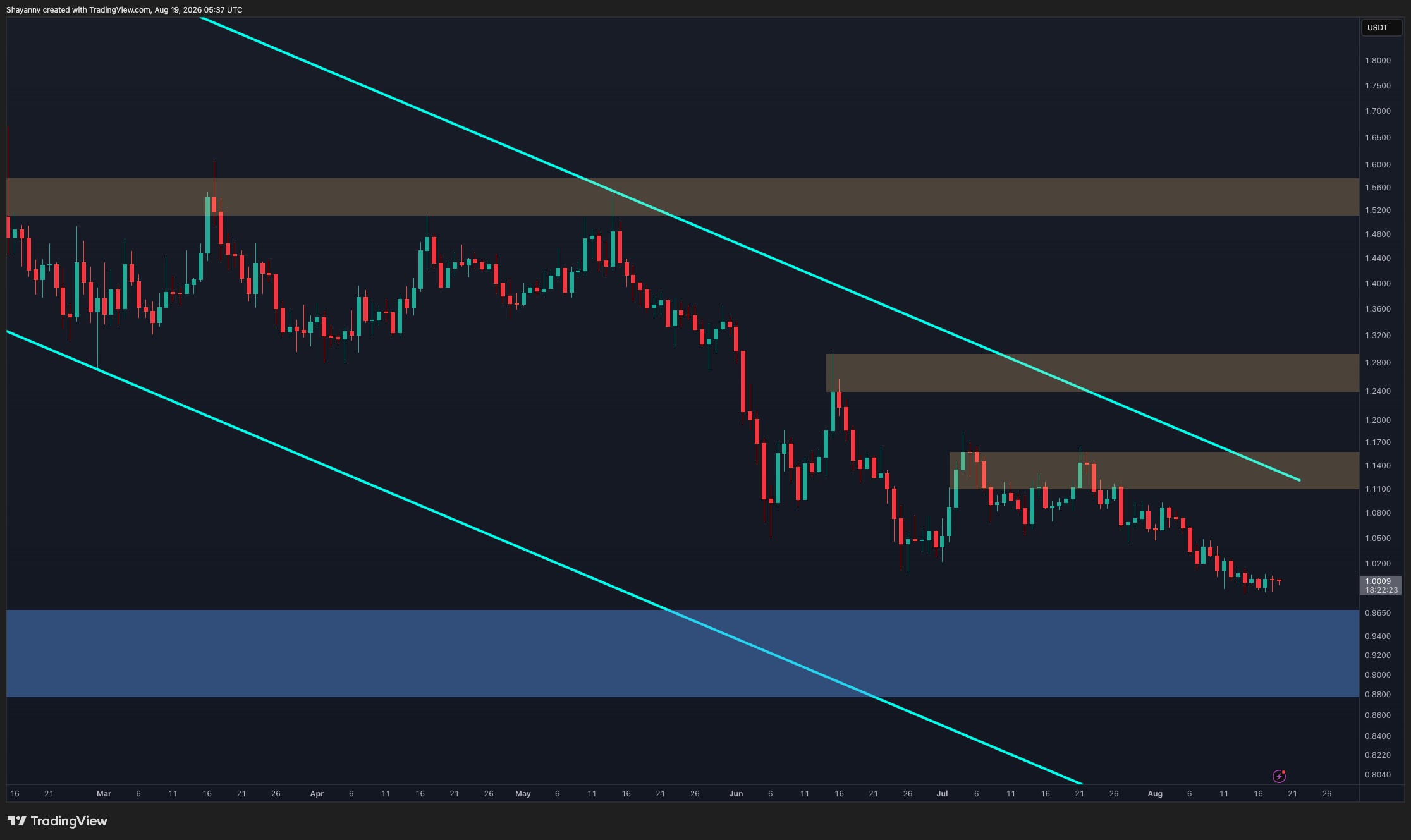
    The article suggests that XRP continues to trade within a large descending channel that has governed its price action for several months, with the sequence of lower highs remaining intact. Key resistance levels are noted in the $1.11-$1.15 area, with the descending channel boundary converging toward the $1.20 region. A more significant supply zone is identified between $1.24 and $1.29. On the downside, the price is approaching a major demand zone between $0.88 and $0.97 on the daily chart, which could attract buyers if the decline extends below $1.

    Short-Term Indicators and Uncertainty

    The 4-hour timeframe presents a more nuanced view. XRP remains beneath a descending trendline and has lost the former $1.02-$1.03 support zone, which has now turned into an important resistance area. Short-term momentum is observed to be compressing, and as per the report, a potential bullish Relative Strength Index (RSI) divergence is developing. While the asset has continued to print lower lows, the RSI has formed higher lows, which may suggest that selling pressure could be weakening. However, this observation does not suggest a reversal by itself, particularly while XRP remains beneath the descending trendline.

    Potential Scenarios and Confirmation Needed

    Several uncertainties surround XRP’s immediate future. The article highlights the need for confirmation before any significant trend shift can be considered underway. A key question is whether XRP can break above the descending trendline and reclaim the $1.02-$1.03 resistance zone. Such a move could potentially trigger a recovery toward the next supply area around $1.06-$1.07. Failure to capitalize on the observed RSI divergence could result in another leg lower, with the $0.94-$0.97 region representing the next major support zone.

    As per the report, the dominant price structure remains downward until the immediate bullish scenario plays out. The analysis emphasizes that while the RSI divergence suggests weakening selling pressure, price confirmation is still required before a meaningful reversal can be considered underway. The $1 level is currently a point of observation, and the market is approaching an important demand area below it. Until higher resistance areas are reclaimed, rallies are likely to remain corrective within the broader downtrend. There is little evidence of a daily bullish structural reversal yet, and buyers would subsequently need to reclaim overhead resistance to suggest it.

    Why This Matters

    The materials describe a narrow update: XRP has fallen back to the $1 psychological level within a descending channel. Whether XRP can break above the descending trendline and reclaim the $1.02-$1.03 resistance zone.

    Broader Context

    Source materials place the market analysis in this context: Ripple’s XRP remains locked in a broader downward structure.