Tag: Neutral

  • USDⓈ-M Perpetual Futures Tick Size Updates Set for July 7-8

    USDⓈ-M Perpetual Futures Tick Size Updates Set for July 7-8

    Binance to Adjust Tick Sizes for USDⓈ-M Perpetual Futures Contracts

    Binance announced it will adjust the tick size, the minimum price fluctuation for a trading pair, on several USDⓈ-M Perpetual Futures Contracts. The changes are scheduled to take effect on specific dates in July 2026, aiming to enhance market liquidity and improve the user trading experience.

    Tick Size Adjustments

    The adjustments will be rolled out in phases. On July 7, 2026, at 06:30 UTC, the tick size for GUAUSDT and YBUSDT will change from 0.0001 to 0.00001. BIGTIMEUSDT will see its tick size decrease from 0.00001 to 0.000001, while FILUSDC will move from 0.001 to 0.0001. PUNDIXUSDT’s tick size will be adjusted from 0.0001 to 0.00001. SYNUSDT’s tick size will be adjusted from 0.00001 to 0.0001.

    The following day, July 8, 2026, will see further adjustments. At 06:30 UTC, FILUSDT’s tick size will be reduced from 0.001 to 0.0001. Later that morning, at 06:40 UTC, MANAUSDT’s tick size will be adjusted from 0.0001 to 0.00001. At 06:50 UTC, QTUMUSDT’s tick size will change from 0.001 to 0.0001. Subsequently, at 07:00 UTC, 1INCHUSDT’s tick size will be adjusted from 0.0001 to 0.00001. At 07:10 UTC, IOSTUSDT’s tick size will decrease from 0.000001 to 0.0000001. Finally, at 07:20 UTC, STORJUSDT’s tick size will be adjusted from 0.0001 to 0.00001.

    Trading Suspension for Specific Contracts

    The tick size adjustments will not impact trading operations for most USDⓈ-M Futures contracts. However, the trading function for FILUSDT, MANAUSDT, QTUMUSDT, 1INCHUSDT, IOSTUSDT, and STORJUSDT Perpetual Futures Contracts will be temporarily suspended.

    The USDⓈ-M FILUSDT Perpetual Futures Contract will be suspended from 06:30 UTC to 06:31 UTC on July 8, 2026. The USDⓈ-M MANAUSDT Perpetual Futures Contract suspension will occur from 06:40 UTC to 06:41 UTC on the same day. For the USDⓈ-M QTUMUSDT Perpetual Futures Contract, trading will be suspended from 06:50 UTC to 06:51 UTC. The USDⓈ-M 1INCHUSDT Perpetual Futures Contract will be suspended from 07:00 UTC to 07:01 UTC. The USDⓈ-M IOSTUSDT Perpetual Futures Contract suspension is scheduled from 07:10 UTC to 07:11 UTC. Lastly, the USDⓈ-M STORJUSDT Perpetual Futures Contract will be suspended from 07:20 UTC to 07:21 UTC.

    During these brief suspension periods, users will be unable to place new orders or cancel and modify existing ones for the affected contracts. The trading status of these contracts will change from “TRADING” to “PENDING_TRADING.” API users can query the latest status using the GET /fapi/v1/exchangeInfo endpoint.

    API and Order Impact

    The tick size changes will also be reflected in API data. API users can retrieve the most current tick size information via the GET /fapi/v1/exchangeInfo endpoint. Further details and updates will be available in Binance’s API Changelog.

    Crucially, these tick size updates will not affect existing orders. Orders placed before the adjustment will continue to be matched using the original tick size.

    This information is provided as a Notice under Binance Exchange Rule 17. Traders are advised to consult the Trading Parameters for comprehensive details and to adjust their trading strategies accordingly to mitigate any potential impact.
  • XRP Price Surge: What’s Next After 8% Weekly Gain?

    XRP Price Surge: What’s Next After 8% Weekly Gain?

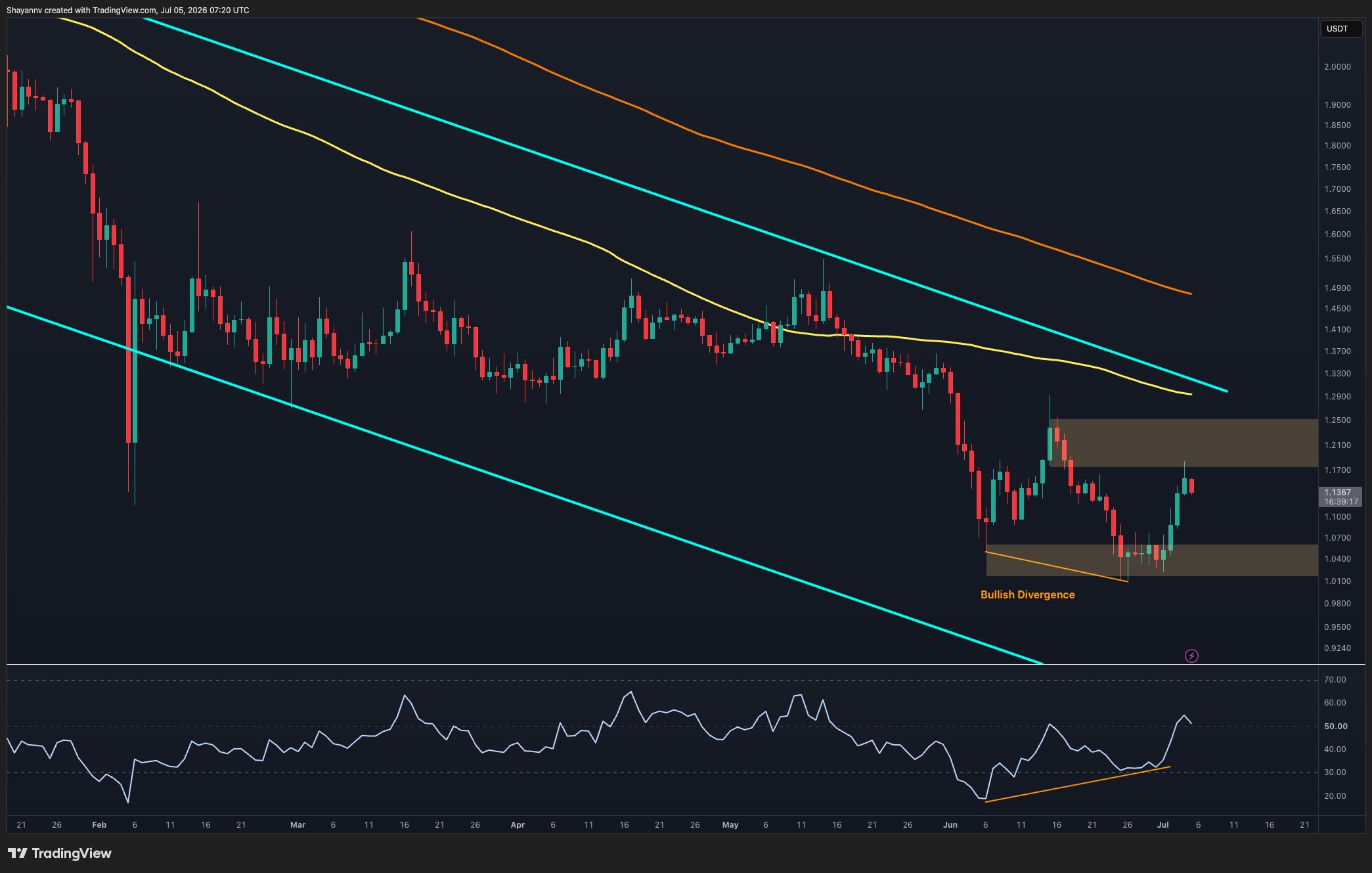
    Ripple’s XRP has staged a significant recovery from recent lows, confirming a bullish divergence that emerged near a key support level. While the broader market structure remains in a corrective phase, the latest surge has propelled XRP back toward a critical technical inflection point that could dictate its next directional move.

    Daily Chart Outlook

    On the daily timeframe, XRP continues to trade within a long-term descending channel. It remains below major moving averages and the upper boundary of this channel. Despite this overarching bearish structure, recent price action has shown considerable improvement.

    The bullish Relative Strength Index (RSI) divergence that formed around the $1.02-$1.05 support zone has played out as anticipated. During this period, XRP was making lower lows while momentum indicators were printing higher lows, signaling a waning selling pressure. Since then, XRP has experienced a sharp rebound, reclaiming the lower support region between $1.02 and $1.06.

    This recovery has now brought the price to the first significant resistance zone, situated between $1.17 and $1.24. This area previously served as support before the recent breakdown and is now acting as a supply zone. The RSI has also moved back above the midline, indicating improving momentum and bolstering the case for a continued recovery attempt.

    However, the broader trend remains bearish as long as XRP trades below the descending channel’s resistance and the overhead moving averages. A successful reclaim of the $1.17-$1.24 region would be the initial indication that the market is attempting to build a larger reversal structure.

    Four-Hour Chart Insights

    The 4-hour chart offers a clearer perspective on the recent breakout. XRP spent several days consolidating within the $1.02-$1.06 demand zone before buyers aggressively intervened, triggering a sharp rally toward the descending trendline resistance.

    This move has already seen XRP reclaim its local support area and push directly into the trendline that has capped higher highs since mid-June. XRP is now testing this dynamic resistance as it approaches the lower boundary of the broader $1.21-$1.29 supply zone.

    This presents a pivotal juncture. A confirmed breakout above the descending trendline would likely pave the way for a move into the upper resistance region, where sellers might attempt to reassert control. Such a breakout would also signify a short-term structural shift after weeks of lower highs and lower lows.

    Conversely, a failure to break through the trendline could lead to a temporary pullback toward the recently reclaimed support zone. As long as XRP remains above the $1.02-$1.06 area, the current recovery structure is expected to hold.

    For the moment, short-term momentum favors the bulls. However, the market is approaching a significant resistance cluster, and a decisive breakout will be necessary to confirm that this recovery is evolving into something more substantial than a mere relief rally.

  • Bitcoin Suffers Worst Month in Four Years: Outlook for July

    Bitcoin Suffers Worst Month in Four Years: Outlook for July

    Bitcoin Suffers Worst Month in Four Years, Eyes July Recovery

    Bitcoin has endured a challenging start to 2026, with the cryptocurrency experiencing losses in four out of the past six months. June proved particularly brutal, marking the worst monthly performance in four years. However, historical data suggests July could offer a reprieve for Bitcoin, and the month has begun with promising signs. The key question now is whether the digital asset can sustain this momentum in the coming weeks.

    May’s Peak and June’s Plunge

    The narrative for Bitcoin in 2026 took a sharp turn in May. Mid-month, the price of Bitcoin surged past $82,000, leading many analysts to believe that the asset had recovered from its earlier losses and was poised for a new bull run.

    This optimism proved short-lived. The rejection at that price level reinforced the “sell in May and go away” sentiment. June saw the cryptocurrency plummet, falling below $70,000 and even dipping below $60,000 on several occasions – a level not seen since before the U.S. presidential elections in late 2024. After shedding approximately $25,000 in a matter of weeks, Bitcoin finally showed early signs of recovery and regained some footing by the end of the month. Despite this late-month rebound, Bitcoin concluded June with a 20.5% loss, its steepest monthly decline in four years.

    Historical Precedent for July

    Analysis of past performance indicates that July has historically been a more favorable month for Bitcoin. In the last 13 years, nine Julys have resulted in gains for the cryptocurrency. Crucially, every July that has followed a losing June has seen Bitcoin finish the month in positive territory.

    The current July has started on a positive note, with Bitcoin trading around $63,000 over the weekend. However, for the month to deliver a much-needed recovery, several factors need to improve in the coming weeks.

    Firstly, the sustained record net outflows from spot Bitcoin Exchange-Traded Funds (ETFs) must cease. These outflows have been a significant impediment to Bitcoin’s progress for months.

    Secondly, recent on-chain data, particularly the Coinbase Premium metric, suggests a lack of genuine demand from U.S. and even Korean investors.

    On a broader macroeconomic front, a de-escalation of tensions or a lasting peace agreement in the Middle East would be beneficial. Additionally, resolving the uncertainty surrounding the upcoming U.S. midterm elections could provide a positive catalyst.

    Despite these headwinds, Bitcoin has recently displayed some bullish signals, rebounding past the significant $60,000 level. Analysts are now closely watching for the next major breakout.

    Crypto analyst Rekt Capital also commented on Bitcoin’s July prospects, suggesting that the cryptocurrency may attempt to retest the 50-Month Exponential Moving Average (EMA), currently around $65,000, as resistance.

    “It’s Green July and history suggests Bitcoin will be looking to turn the 50-Month EMA (purple) into new resistance,” Rekt Capital posted on X (formerly Twitter) on July 4, 2026, alongside a chart illustrating the trend.

  • AI Safety a Pretext for Frontier Tech Lockdown, Says Perplexity Co-Founder

    AI Safety a Pretext for Frontier Tech Lockdown, Says Perplexity Co-Founder

    AI Safety Debate Criticized for Concentrating Power, Not Preventing Harm

    The conversation around artificial intelligence safety is fundamentally flawed, according to Andy Konwinski, co-founder of Perplexity AI and Databricks. He argues that the focus on safety is being exploited to consolidate power rather than genuinely mitigate risks. Konwinski articulated this perspective in a recent essay, with the AI company Anthropic serving as a key example.

    Anthropic’s Reversal Highlights Concerns

    Konwinski’s argument centers on a decision made by Anthropic that was reversed within 48 hours. On June 9, when Anthropic released Claude Fable 5, a detail within its extensive 319-page system card revealed that the model would subtly degrade its responses for users suspected of training competing AI systems.

    The discovery of this provision by researchers quickly drew widespread criticism online. While Anthropic rescinded the policy, Konwinski contends that this retraction does not alter the broader implications. “The problem isn’t that Anthropic made a bad decision,” he wrote. “The problem is that they assumed the decision was theirs to make.”

    “Concentration of Power in AI” Essay and Laude Institute Meeting

    Konwinski’s essay, titled “Concentration of power in AI is a risk, not a solution,” was published following “Open Frontier,” a working meeting he organized through his nonprofit, the Laude Institute. The event took place at San Francisco’s Exploratorium on June 30 and was attended by approximately 100 researchers.

    Western Open Frontier Model Lacking, Safety Messaging Questioned

    Jennifer Chayes, dean of UC Berkeley’s College of Computing, Data Science, and Society, recently told a funding panel that Berkeley researchers are “all building on Chinese models because we don’t have a Western open frontier model.” She further characterized the safety messaging from OpenAI and Anthropic, particularly in the lead-up to their initial public offerings, as a “very effective fear campaign.”

    Centralized Access Creates New Risks

    Konwinski’s core argument is that centralizing access to AI does not eliminate risk; instead, it introduces a new set of dangers. He likens AI to foundational infrastructure such as railroads, electricity, and the internet, technologies that reshaped society based on control of their underlying layers. AI, he posits, is poised to do the same. As an alternative, Konwinski advocates for a “research commons” that provides frontier-scale computing resources, enabling leading researchers to advance the field without requiring permission from private laboratories.

    LeCun Echoes Concerns on Power Concentration

    Yann LeCun, Meta’s former chief scientist, publicly supported Konwinski’s essay on X (formerly Twitter). “I’ve been disseminating a similar message for years,” LeCun stated. “The concentration of power in AI and the desire for control is by far the biggest danger of AI.”

    LeCun drew a historical parallel, comparing the current situation to “medieval obscurantism akin to the Ottoman empire banning the use of the printing press for 200 years, in part to keep control of the dogma, but also to protect the corporation of the calligraphers and scribes.”

    Infrastructure Will Be Open, Applications Will Drive Profit

    LeCun predicts that the future of AI infrastructure will be open. “Infrastructure wants to be open,” he wrote. “Foundation models are becoming an infrastructure and will inevitably become commoditized. Long term, the money is in the application layer.”

    Following his departure from Meta in late 2025, LeCun launched AMI Labs in Paris in March 2026 with $1.03 billion in seed funding. This venture, which operates on world models and his JEPA architecture, plans to open-source its research and does not anticipate a commercial product for several years, representing his own approach to the evolving AI landscape.

  • Ripple Announces July 4 Update

    Ripple Announces July 4 Update

    Ripple Joins Initiative to Support Unemployed Veterans on US Independence Day

    As the United States, the world’s most powerful economy and a leading global democracy, approaches its 250th Independence Day, various initiatives are surfacing to mark the occasion. Among them is a new commitment from Ripple, the company behind the popular XRP altcoin.

    Ripple has announced its participation in a nonprofit organization dedicated to helping unemployed veterans secure high-quality jobs following their military service. The organization, known as the Call of Duty Endowment, has already assisted over 165,000 veterans. However, it highlights a persistent high unemployment rate among younger veterans, indicating that “there’s still more work to do.”

    The Call of Duty Endowment aims to place 200,000 veterans into employment by 2030. Ripple’s involvement is part of a special initiative for the US’s 250th birthday, dubbed #Giving4th, which seeks to establish Independence Day as a national day of charitable giving. Ripple has pledged to match donations made to the Call of Duty Endowment, up to a total of $10,000.

    Individuals wishing to contribute can do so through various means, including cash, stock, or cryptocurrencies. Notably, Ripple’s own native tokens, XRP and RLUSD, are also accepted for donations.

    The Fourth of July, celebrated annually on July 4th, commemorates the adoption of the Declaration of Independence in 1776 and is a federal holiday in the United States.

  • XRP: Fakeout or Prelude to Volatility?

    XRP: Fakeout or Prelude to Volatility?

    XRP Derivatives Signal Cautious Optimism Amidst Shifting Market Dynamics

    XRP is currently exhibiting a notable derivatives setup among large-cap altcoins. While its price is experiencing a gradual ascent, open interest has been declining. Typically, this scenario suggests traders are withdrawing from the market. However, when coupled with a rising net position delta, it warrants closer observation.

    Short Covering Fuels Current Uptrend

    According to analysts, the recent uptrend in XRP appears to be primarily driven by the closure of short positions rather than aggressive new buying. In simpler terms, bearish traders are exiting the market, and this short-covering pressure is contributing to XRP’s price increase. While this can support a steady upward movement, it is insufficient for a sustained rally. A genuine acceleration typically occurs when new buyers enter the market with conviction.

    Open Interest Reflects Waning Conviction

    The significance of open interest lies in its indication of leverage. A decreasing open interest suggests a reduction in leverage, not an increase, which is generally a sign of waning conviction among traders.

    Daily Outlook and Key Resistance Levels

    The daily outlook supports a cautious bullish bias. XRP closed bullishly in yesterday’s trading session, but it must maintain this position to avoid slipping back into weaker territory. Consequently, a move towards the resistance level at $1.13 is crucial. Stronger momentum could potentially drive the price even higher.

    The Real Trigger for Acceleration

    The key signal that traders should monitor is a simultaneous increase in both open interest and net position delta. This would indicate a market shift from an environment where price increases are driven by short covering to one where new long positions are being established. Such a shift could lead to a more rapid acceleration in XRP’s price.

    Intraday Volatility and Potential Breakout

    Intraday, XRP remains relatively volatile and confined within a trading range. A successful push above and sustained hold of $1.18 could present an opportunity for buyers to re-enter the market with significant force.

    For the time being, the signal is clear: bears appear to be relinquishing their hold, but bulls have yet to enter the market with decisive conviction.

  • XRP Price Surge Predicted by MVRV Data

    XRP Price Surge Predicted by MVRV Data

    XRP Price Hovers Near $1, Amid Deepest On-Chain Signals in History

    XRP is currently trading in the $1.00 to $1.10 range, while on-chain data is flashing some of the most significant predictive signals seen in the token’s history. Both short-term and long-term holders are experiencing substantial unrealized losses, a rare combination that typically captures the attention of traders. Nevertheless, for bulls to claim a sustained trend reversal, a decisive breakout is still required.

    On-Chain Metrics Signal Extreme Pessimism

    Santiment data reveals XRP’s 30-day MVRV (Market Value to Realized Value) at approximately -45%, with its 365-day MVRV near -47%. This represents the weakest combined reading across both timeframes on record, indicating that most holders are currently “underwater,” regardless of their purchase date. While extreme market pain is rarely permanent, accurately timing a recovery remains a challenge.

    MVRV-Z Score and Golden Cross Offer Hope

    The MVRV-Z Score has remained below zero for nearly two weeks, mirroring conditions observed before previous significant recoveries. Concurrently, analysts are observing a fresh MVRV golden cross, with the ratio climbing back above its 200-day moving average. If this signal holds, long-term momentum could begin to shift.

    Key Resistance Levels to Watch

    However, the broader cryptocurrency market remains fragile, which could potentially slow any recovery. The resistance zone between $1.15 and $1.20 is therefore a critical level to monitor. A clear break above this range would bolster the bullish case, whereas another rejection could prolong XRP’s current stagnation.

    XRP is consolidating after a bounce from recent yearly lows. Trading volume remains elevated, indicating an ongoing battle for control between buyers and sellers, with neither side yielding ground.

    The first significant resistance lies around the $1.15 to $1.20 mark. A convincing breakout above this zone would provide the initial meaningful indication of a shift in momentum. Beyond this, traders are watching the $1.35 area, with stronger resistance appearing closer to the long-term downtrend.

    Potential Scenarios for XRP

    Several paths remain open for XRP. If the token defends its support levels and breaks through resistance with strong volume, bullish momentum could accelerate rapidly. Alternatively, extended consolidation could allow on-chain metrics to recover while the market seeks a new direction. Sometimes, markets simply require patience.

    A daily close below the psychological $1.00 level would diminish the bullish outlook and increase the risk of further downside. Nevertheless, the deeply negative MVRV readings suggest that much of the prevailing pessimism has already been priced in. While this does not guarantee a rally, it keeps the possibility of a recovery alive.

    Investment Considerations for Large-Cap Assets

    While XRP’s MVRV setup is compelling, at its current market capitalization, the potential for asymmetric upside for cycle traders is structurally limited compared to opportunities in earlier-stage projects. This is an unavoidable reality when considering a recovery play in a large-cap asset versus positioning in infrastructure still in its price discovery phase. This distinction does not render XRP a poor trade, but it fundamentally alters the expected return profile.

    LiquidChain: A New Cross-Chain Liquidity Layer

    LiquidChain, an L3 infrastructure project, is positioning itself as a cross-chain liquidity layer, aiming to unify liquidity from Bitcoin, Ethereum, and Solana into a single execution environment. Its architecture features a Unified Liquidity Layer, Single-Step Execution, and a Deploy-Once model, enabling developers to access all three ecosystems without the need for chain-specific rebuilding.

    The project’s presale is currently priced at $0.01476, having raised $880,000 to date. For traders exploring a recovery thesis based on broader crypto sentiment, researching LiquidChain’s presale structure alongside larger-cap investments could prove worthwhile.

  • Bitcoin Bounces Back to $62K Amid ETF Inflows and Trump Holdings Buzz

    Bitcoin Bounces Back to $62K Amid ETF Inflows and Trump Holdings Buzz

    Crypto Market Sees Tentative Relief as Bitcoin Recovers

    Although July has just begun, the past seven days have brought some much-needed and long-awaited relief to the cryptocurrency market, even as overall sentiment remains fragile.

    Last week at this time, Bitcoin was still struggling around the $60,000 mark following a painful correction in June. The cryptocurrency spent the weekend moving mostly sideways, with neither bulls nor bears able to gain decisive control.

    The real action commenced at the start of the business week. BTC attempted a recovery but was quickly rejected near $60,700, allowing sellers to push it lower. Pressure intensified on Tuesday, when Bitcoin, along with the broader market including the S&P 500, the Nasdaq, and major tech stocks, experienced a significant downturn. BTC dipped below $59,000 and slipped toward $58,000 on some exchanges, marking its intraweek low.

    However, that support held firm. The cryptocurrency bounced back and swiftly reclaimed $60,000. Later, it pushed toward $62,000 as buyers returned and spot Bitcoin ETFs finally saw renewed inflows after a brutal streak of outflows.

    Altcoins also managed to follow suit, with some even posting sharper gains. ETH recovered strongly, moving back toward $1,700, while SOL was among the top performers with a double-digit weekly jump. XRP, DOGE, ADA, XLM, and HYPE also joined the rebound, helping the total crypto market capitalization recover some of its recent losses.

    Key Developments and Market Insights

    The week was also marked by several major headlines. Donald Trump’s latest financial disclosure revealed he holds over $50 million in Bitcoin, reigniting strong debates. FBI Director Kash Patel also amended a disclosure related to Strategy’s stock, while Securitize made its NYSE debut and launched tokenized shares on Solana and Avalanche.

    Overall, bulls were finally able to stop the bleeding. However, this does not necessarily mean the worst is over. BTC still requires a decisive breakout above pivotal levels around $70,000 to prove this was more than just a temporary rebound.

    Market Cap: $2.22T | 24H Vol: $66B | BTC Dominance: 56%
    BTC: $62,000 (+2.7%) | ETH: $1,731 (+9.6%) | XRP: $1.12 (+7.2%)

    Tokenized Stocks Emerge as Altcoin Lifeline Amid Crypto Market Reset

    A new report suggests that tokenized stocks are becoming one of crypto’s few bright spots, as persistent token unlocks and weak altcoin narratives continue to weigh down speculative assets. Analysts also noted that Solana is currently dominating tokenized equity trading alongside Hyperliquid’s HIP-3.

    Why Bitwise’s Matt Hougan Thinks Strategy’s Bitcoin Era Is Fading

    Matt Hougan, CEO of Bitwise, believes that Strategy’s role as a major corporate Bitcoin buyer is likely to diminish. He anticipates that future cycles could be led by institutions such as banks, asset managers, pension funds, and sovereign wealth funds.

    Standard Chartered Becomes First Major Bank to Offer Direct Stablecoin Services

    Standard Chartered has become the first major global bank to offer direct USDC minting and redemption services to institutional clients through its banking platform. The service was launched in partnership with Circle in Dubai’s DIFC.

    Can Circle Defend Its Stablecoin Lead Against OpenUSD? Experts Weigh In

    Experts, however, have warned that Circle may face one of its toughest challenges yet from OpenUSD, a new stablecoin backed by major financial and payments firms including Visa, Mastercard, BlackRock, and Coinbase.

    UK Investors Sue Binance and Former CEO Changpeng Zhao for $200M

    A group of 1,700 UK investors has filed a lawsuit against Binance and its former CEO, Changpeng Zhao, in London’s High Court. The plaintiffs are seeking approximately $200 million in damages, alleging that the exchange sold unauthorized derivatives products.

    The Vanishing Bitcoin Bid: Where Are the ETF Billions Going?

    Tim Sun of HashKey research suggests that recent Bitcoin ETF outflows may reflect capital rotating into AI, semiconductors, and GPU-related stocks, rather than a complete collapse in risk appetite.

    This week’s analysis includes charts for Ethereum, Ripple, Cardano, Binance Coin, and Hyperliquid.

  • Binance Unveils Major User-Facing Update

    Binance Unveils Major User-Facing Update

    Binance Expands to Philippines Amid EU Regulatory Scrutiny

    The world’s largest cryptocurrency exchange, Binance, is facing significant challenges with European Union financial regulators, a situation that has sparked concern among its user base. Despite these European hurdles, Binance has simultaneously bolstered its global footprint with its official entry into the Philippines.

    The expansion was announced by Binance’s co-founder and chief customer service officer, Yi He, via her personal X account. She shared a document indicating that the Securities and Exchange Commission (SEC) in the Philippines has granted final approval to Blockshoals Technologies Inc. to pilot its financial products and services within the regulator’s sandbox environment.

    Under this crypto-asset intermediary model, Blockshoals’ Stratbox will provide Filipino users with access to a suite of offerings facilitated by its global crypto-asset service provider (CASP) partner, Binance.

    Binance founder Changpeng Zhao, widely known as CZ, also acknowledged the development, retweeting Yi He’s post and commenting, “Real liquidity for Philippines.”

    The move into the Philippines has been met with mixed reactions from users. Some view the expansion as a positive step for cryptocurrency adoption in the region. However, others are skeptical, suggesting the announcement is an attempt to divert attention from Binance’s ongoing regulatory issues in the European Union.

    The exchange recently withdrew its Markets in Crypto-Assets (MiCA) license application from the Hellenic Capital Market Commission (HCMC) in Greece. This decision leaves Binance without the necessary authorization to operate within the EU after July 1. Binance has stated that user assets remain secure and reiterated that Europe is a crucial market for its operations, expressing hope to secure the required permit in the near future. In the interim, some clients have reported receiving withdrawal instructions from the company, while others appear unaffected.

    Adding to its European regulatory pressures, a group of 1,700 UK investors has initiated a collective lawsuit against Binance and CZ in London’s High Court. The claimants allege that the exchange offered unregulated products, resulting in substantial financial losses, and failed to provide adequate client protection.

  • US Citizen Accused of Spying for Iran in Israel

    US Citizen Accused of Spying for Iran in Israel

    American Student Indicted on Espionage Charges in Israel

    An American citizen studying at an ultra-Orthodox seminary in Jerusalem has been indicted on espionage charges, marking what authorities describe as the first prosecution of a U.S. national amid an intensifying crackdown on Israelis allegedly recruited to spy for Iran.

    Eli Lavon, 21, was formally charged Friday with two counts of contact with a foreign agent and 14 counts of communicating information that could benefit an enemy, according to an indictment filed by the State Attorney’s Office.

    Prosecutors allege the case began in November 2025, when Lavon, during a visit to relatives in the United States, responded to a job posting on the Telegram messaging app. A month later, as he was returning to Israel, an individual claiming to represent Iranian intelligence made contact and began assigning him surveillance tasks, the indictment states.

    These alleged tasks included filming an abandoned building in a religious Jerusalem neighborhood and recording footage inside a grocery store. In one instance, prosecutors claim, Lavon was instructed to conceal a cigarette pack containing a note reading “The job is complete” in a trash can at a Jerusalem shopping mall.

    He was reportedly paid in cryptocurrency for the material he provided, communicating through two Telegram accounts and three mobile phones, according to the charges.

    After severing contact with the first handler, prosecutors say Lavon began communicating with a second Iran-linked operative. This involved hiding a flash drive wrapped in currency at a restaurant and sending a photograph of his passport. The second handler allegedly pressed Lavon for the names of his fellow seminary students, which he declined to provide, the indictment details. Prosecutors estimate his combined payments from both handlers totaled approximately $1,379.

    “This indictment illustrates how foreign intelligence agencies attempt to exploit the digital sphere to identify, recruit, and operate individuals from within Israel,” said Ronit Shentzer Yaakobi of the Jerusalem District Attorney’s Office. “It also highlights the critical importance of remaining vigilant and immediately severing contact when approached in this manner.”

    Lavon’s attorney, Raz Bar Tzvi, told CNN that being contacted online by a foreign actor does not automatically make someone a spy. He argued that the facts presented in the indictment do not support the charges and declined to state how his client would plead.

    Since 2023, Israel has indicted approximately 60 individuals on Iran-related espionage charges. Officials claim that several sites allegedly surveilled by such recruits were subsequently targeted in Iranian missile attacks.