Tag: Negative

  • ChatGPT’s Latest Prediction Disappoints XRP Holders

    ChatGPT’s Latest Prediction Disappoints XRP Holders

    The cryptocurrency market has experienced a dramatic downturn in recent weeks, far exceeding expectations from mid-May. Bitcoin (BTC) has fallen below the $60,000 mark for the first time since November 2024, while Ethereum (ETH) has plunged to a 14-month low. XRP has also succumbed to the selling pressure, dropping below critical support levels and reaching a 19-month low of under $1.10 on Friday.

    The immediate concern for XRP investors is whether the current support above the crucial psychological threshold of $1.00 will hold, or if the cross-border payment token is destined for a significant decline into the sub-dollar range.

    According to a new analysis from a prominent AI solution, the most probable initial bearish target for XRP, should it breach $1.00, is $0.90. This scenario appears increasingly likely given the prevailing market conditions. For context, Bitcoin’s recent dip below $60,000 marked its lowest point since before the U.S. elections in late 2024.

    Similarly, XRP has retreated to its lowest levels since that period in November 2024, currently trading below $1.10. Having broken through its last significant support at $1.00, this level is now under intense scrutiny, with a further downward move potentially testing it imminently.

    The AI model suggests that a drop to $0.90 would represent an additional 18%-20% decline for XRP and would likely be accompanied by continued weakness across the broader cryptocurrency market.

    However, the AI also outlined even more pessimistic scenarios should bullish sentiment completely evaporate. In a more extreme bearish outlook, XRP could fall to the $0.75-$0.80 range.

    A full capitulation scenario, while considered a “low-probability outcome,” envisions XRP dropping to $0.60. The AI platform noted that such a drastic decline would likely require a confluence of factors, including macroeconomic instability, a widespread crypto bear market, and the erosion of key positive narratives like ETF optimism and institutional adoption.

    Conversely, the AI also presented a more optimistic perspective, suggesting that XRP might be “approaching a point where conditions become favorable for a relief rally.” Drawing on historical data, particularly for previous Junes in U.S. midterm election years, the AI highlighted that “pessimism often preceded major recoveries.”

    Based on this, the AI outlined a potential for a swift rebound to $1.25 and even $1.40, contingent on buyers successfully defending the $1.05-$1.10 support region. The coming days, or even hours, will be crucial in determining whether this support holds.

  • Binance Fuels Massive Crash for Four Altcoins

    Binance Fuels Massive Crash for Four Altcoins

    Binance Delists Four Altcoins, Triggering Significant Price Drops

    Major cryptocurrencies like Ethereum (ETH), Ripple (XRP), and Solana (SOL) have seen declines of 5% to 8% in the past 24 hours, mirroring a broader downturn in the market. However, four less prominent tokens have experienced far more severe losses, with the primary catalyst identified as Binance.

    The world’s largest cryptocurrency exchange recently completed another review of the digital assets available on its platform. This assessment evaluated whether the tokens met industry standards, including factors such as team commitment, development activity, trading volume, liquidity, and network stability.

    Following this analysis, Binance announced it would cease all services for Contentos (COS), Dar Open Network (D), Highstreet (HIGH), and MOBOX (MBOX). The delisting is slated for June 19, but the announcement alone has already led to a sharp price collapse for the affected coins. Each has fallen by over 25% in a single day, with COS suffering the most significant decline, dropping approximately 31%.

    Such drastic price volatility is not unexpected. Losing support from a major exchange like Binance typically results in reduced liquidity, decreased accessibility, and reputational damage for the delisted assets.

    This move follows a similar pattern from just a few weeks prior, when Binance delisted Automata (ATA), Harvest Finance (FARM), Enzyme (MLN), Phoenix (PHB), and Syscoin (SYS), which also triggered notable price reactions.

    Binance also removed several trading pairs, including AXL/BTC, CRV/BTC, EGLD/BTC, OPN/BNB, POL/ETH, QTUM/USDC, and SKY/BTC. While this action did not result in a substantial price drop, the complete termination of trading services for the four aforementioned tokens has had a more pronounced impact.

    Binance to Support NEAR Protocol Network Upgrade

    In separate news, Binance has confirmed its support for the upcoming NEAR Protocol (NEAR) network upgrade and hard fork, scheduled for June 10. The exchange will temporarily suspend token deposits and withdrawals on the NEAR blockchain during this period.

    Binance has pledged to manage all technical aspects for its users, assuring that operations will resume once the upgraded network is deemed stable. The exchange also stated that trading of the NEAR token will not be affected.

    This type of network upgrade support is a standard procedure that Binance has undertaken multiple times previously, with no significant complications reported to date. In late May, the exchange briefly halted deposits and withdrawals on the Ethereum network for wallet maintenance. Prior to that, similar measures were implemented to support upgrades across other blockchain ecosystems, including Cardano and BNB Chain.

  • Zcash Plummets, Erasing Billions in Market Cap—Can ZEC Rebound?

    Zcash Plummets, Erasing Billions in Market Cap—Can ZEC Rebound?

    Zcash Plummets After Discovery of Four-Year-Old Vulnerability

    Zcash (ZEC) experienced a dramatic price drop of over 40% in a single day following the revelation of a four-year-old vulnerability within one of its core privacy transaction pools. The flaw, which could have potentially allowed for the unlimited minting of ZEC, sent shockwaves through the investor community.

    The network’s native token has seen a 35% decline in the past 24 hours, recently trading around $339. During the sell-off, ZEC briefly dipped below $300, marking its lowest point since early April and erasing billions from its market capitalization. This sharp downturn follows a significant rally, where the token had climbed from below $200 in March to a high of $675 by the end of May.

    The recent gains have now been wiped out, leaving investors who had bet on the coin’s upward trajectory questioning Zcash’s ability to regain its momentum.

    “The news emerged at a time when the privacy narrative was gaining significant traction, and ZEC had already tripled its value since April, outperforming Bitcoin and other major cryptocurrencies,” Ish Asad, a research analyst at Bitwise Research, told Decrypt. “The timing of this disclosure is precisely why ZEC plummeted 40%.”

    The severity of the price decline is also attributed to the lingering uncertainty surrounding the situation. Although the vulnerability was patched earlier this week, the nature of the Zcash network means it remains unclear whether malicious actors may have exploited the bug to create counterfeit ZEC tokens.

    “The price reaction is more a reflection of that uncertainty than the bug itself,” explained Nicolai Sondergaard, a research analyst at blockchain analytics firm Nansen. “A patched vulnerability in a lesser-known privacy coin would typically be a minor issue. The 30% drop indicates the market is assigning a non-trivial probability to the scenario where some counterfeiting did occur and is permanently undetectable without the proposed upgrade.”

    Zcash, which had neared $700 in November and recently approached that level again, has been a standout performer in the cryptocurrency market over the past year, with gains exceeding 580%, even after accounting for its recent sharp decline.

    However, a swift recovery of its recent gains appears unlikely, according to Jake Kennis, a senior research analyst at Nansen. Kennis pointed to the substantial price drop and the significant increase in trading volume during the sell-off, which exceeded $3 billion in the last 24 hours as of this writing.

    “It would likely require either a broader resurgence of the privacy coin narrative and demand for privacy, a major protocol-level catalyst, or a larger rotation into privacy assets,” he told Decrypt, adding that a token typically needs to “find its footing” after such a sell-off before it can rebound.

    In contrast, Asad believes that traders may be reacting prematurely to the disclosure. “Often, the market gets ahead of itself and reprices assets, sometimes dramatically, in real time,” he stated. “But the fundamental story remains unchanged: Zcash is a clone of Bitcoin with added privacy and encryption features, which will carve out its own market.”

    BitMEX founder Arthur Hayes appears to be among those acting on this real-time assessment. He informed his social media followers that he had sold his entire ZEC holdings, partly because the exploit “violated his narrative mental map.” Despite this, Hayes asserted that “privacy is priceless” and indicated he would have no issue repurchasing ZEC at higher prices should the cryptocurrency recover.

    Meanwhile, the question arises whether other privacy coins could benefit from the fallout surrounding Zcash and attract traders disillusioned by the vulnerability. Nansen’s Kennis, however, does not foresee this happening in the immediate future.

    “I don’t believe a potential vulnerability in a privacy protocol like this would be seen as a positive catalyst for any of its competitors in the near term,” he concluded.

  • Pi Network Hits Major Milestone Amidst Price Plunge

    Pi Network Hits Major Milestone Amidst Price Plunge

    Pi Network Completes Major Milestone Amidst Price Plunge

    The team behind the controversial cryptocurrency project has rolled out a significant upgrade aimed at bolstering its entire ecosystem. However, this positive development has failed to spur a recovery for PI, whose valuation has plummeted to a new all-time low.

    Recent Protocol Advancements

    Pi Network has demonstrated considerable progress in recent months. In February, the Core Team introduced protocol version 19.6, followed by an upgrade to v19.9. Subsequently, they launched the highly anticipated v20.2, which laid the groundwork for smart contract functionalities.

    Last month, the team announced a migration to protocols v22 and v23, setting June 2 as the deadline for transitioning to v24. This update was shared on Pi Network’s official X account earlier today, June 5.

    “Great job to all Nodes! This was one of the most challenging migrations,” the announcement stated.

    The upgrade to protocol 24 primarily focuses on enhancing the underlying infrastructure that supports node operations and mainnet activity. The Core Team has indicated that migration to v25 is the next step, with June 18 designated as the completion deadline.

    Expansion into Gaming

    In addition to protocol updates, Pi Network has recently made further strides in the gaming sector. CiDi Games, a company within the Pi Network Ventures portfolio, has released four new games for Pioneers: Coin Whack, Fruit Stack, Gemnova, and RainbowCubes.

    Persistent Price Suppression

    Despite these developments, PI’s valuation remains heavily impacted by the prevailing bear market and the recent market-wide pullback across the cryptocurrency landscape.

    Earlier this week, the token’s price collapsed to a new all-time low of approximately $0.12. This represents a 33% decrease for the month and a staggering 96% drop from its historic peak of $3, recorded at the beginning of 2025. PI’s market capitalization has consequently fallen to around $1.3 billion, positioning it as the 58th-largest cryptocurrency.

    Indicators of Further Correction

    Several factors suggest that an additional price correction may be imminent. Data indicates a substantial increase in PI coins held on exchanges, with over 500,000 coins added in the past 24 hours, bringing the total to over 550 million. This surge suggests that a significant number of investors have moved their holdings to centralized platforms, potentially increasing immediate selling pressure.

    Upcoming token unlocks also present a potential challenge, with approximately 160 million PI tokens slated to enter circulation within the next 30 days. June 11 is projected to be a notable day, with 16 million coins scheduled for release. While this does not guarantee a steeper decline, it could provide an opportunity for some investors to liquidate long-held tokens.

  • XRP Price Plunge Risk: What Happens If $1 Support Fails?

    XRP Price Plunge Risk: What Happens If $1 Support Fails?

    XRP Begins June With Steepest Decline in Three Months

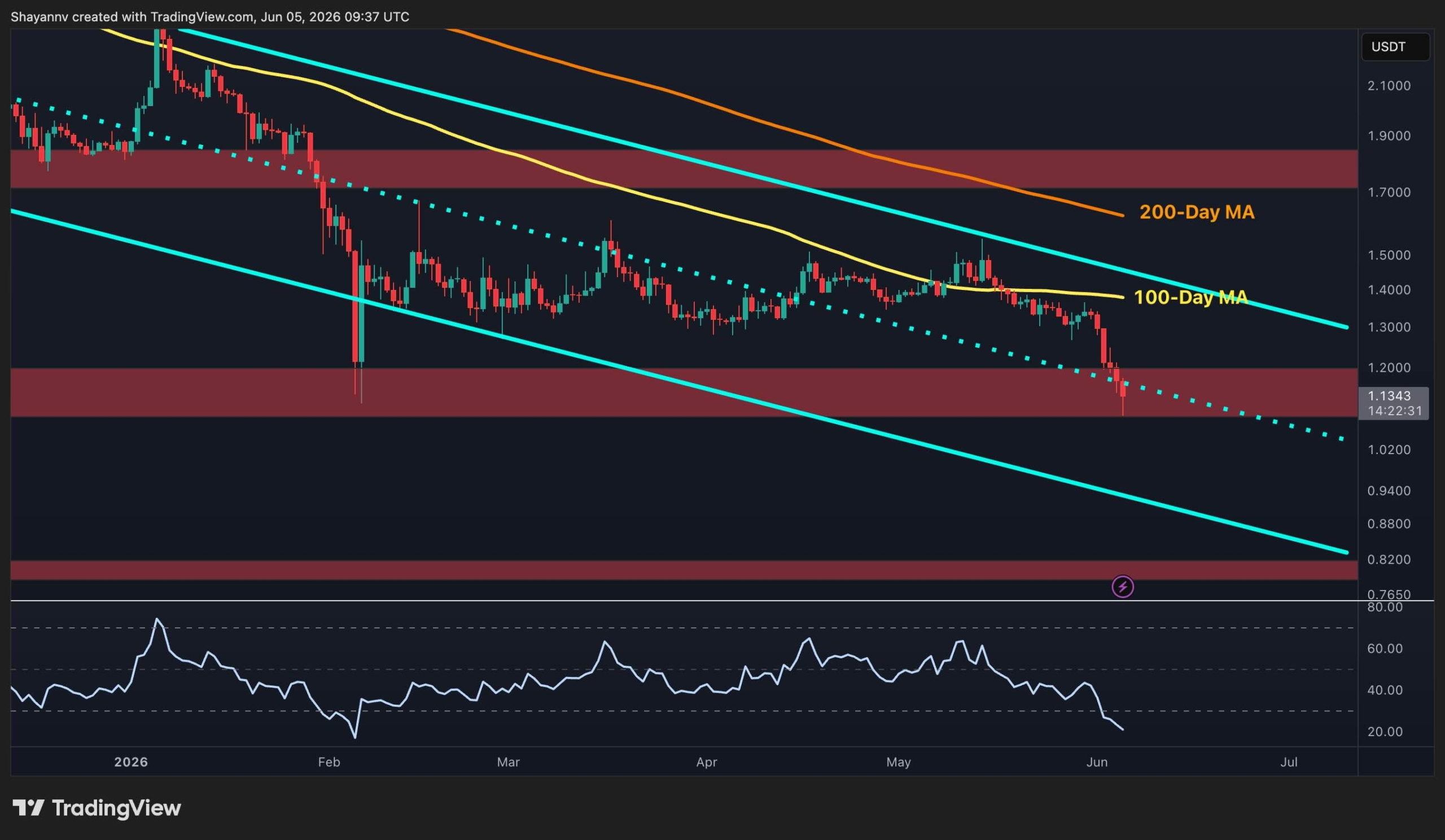
    XRP has opened June with its most significant price drop in the past three months, as the critical $1.20 support level, which had acted as a firm floor for months, is now being breached. The cryptocurrency is currently trading at $1.11. The Relative Strength Index (RSI) is also registering its lowest point since the capitulation seen in February, with the next significant support level appearing to be approximately $0.30 lower. Analysts suggest this is not merely a pullback from resistance but rather a breakdown of XRP’s last line of defense.

    On the USDT chart, the $1.20 support band, which proved resilient during the February market crash and had remained untouched since, is now on the verge of collapse. The RSI has similarly plummeted to around 20-25, nearing the oversold territory observed during the February capitulation low. This reading alone is noteworthy, as historically, RSI levels at this extreme have preceded at least a sharp relief bounce, even within a broader downtrend.

    However, an oversold RSI does not automatically signal that a bottom has been established. The $1.20 level is now likely to transition into resistance. For the current breakdown to be considered reversed rather than merely paused, any subsequent bounce would need to reclaim this level on a sustained closing basis.

    Below the current trading price, the next key structural reference point is the $0.80 demand zone. This area also aligns with the lower boundary of a descending channel, presenting a significant confluence of support, albeit at a considerably lower valuation. With the 100-day moving average at $1.35 and the 200-day moving average at $1.60 now both acting as substantial overhead resistance, the USDT-paired chart shows XRP facing considerable selling pressure above and limited structural support below.

    XRP/BTC Pair Shows Greater Resilience

    In contrast, the BTC pair is presenting a more robust picture. XRP/BTC is currently trading at 1,800 satoshis, holding above recent lows of 1,740 satoshis. The RSI, which had surged to 70 at the end of May, suggesting a potential shift in momentum, has since retreated to 50. This indicates that the brief period of strength has not translated into sustained buying pressure.

    The price is trading below the short-term resistance of 1,850 satoshis, having been rejected at this level once again. The declining 100-day moving average, situated around 1,900 satoshis, is acting as immediate dynamic overhead resistance. The fact that the XRP/BTC ratio has held its ground while the USDT pair has weakened suggests that XRP’s dollar-denominated weakness is partly attributable to broader altcoin selling pressure rather than a specific deterioration of XRP’s standing against Bitcoin.

    A confirmed close below 1,740 satoshis on the BTC pair, especially if it occurs concurrently with continued weakness in the USDT pair, would signify a definitive breakdown across both pairings. Such a scenario would expose the 1,500 satoshis area as the next significant level of support.

  • Bitcoin Price Analysis: BTC’s Next Move After Falling Below $61K

    Bitcoin Price Analysis: BTC’s Next Move After Falling Below $61K

    Bitcoin Faces Intense Selling Pressure After Breaching Key Support Levels

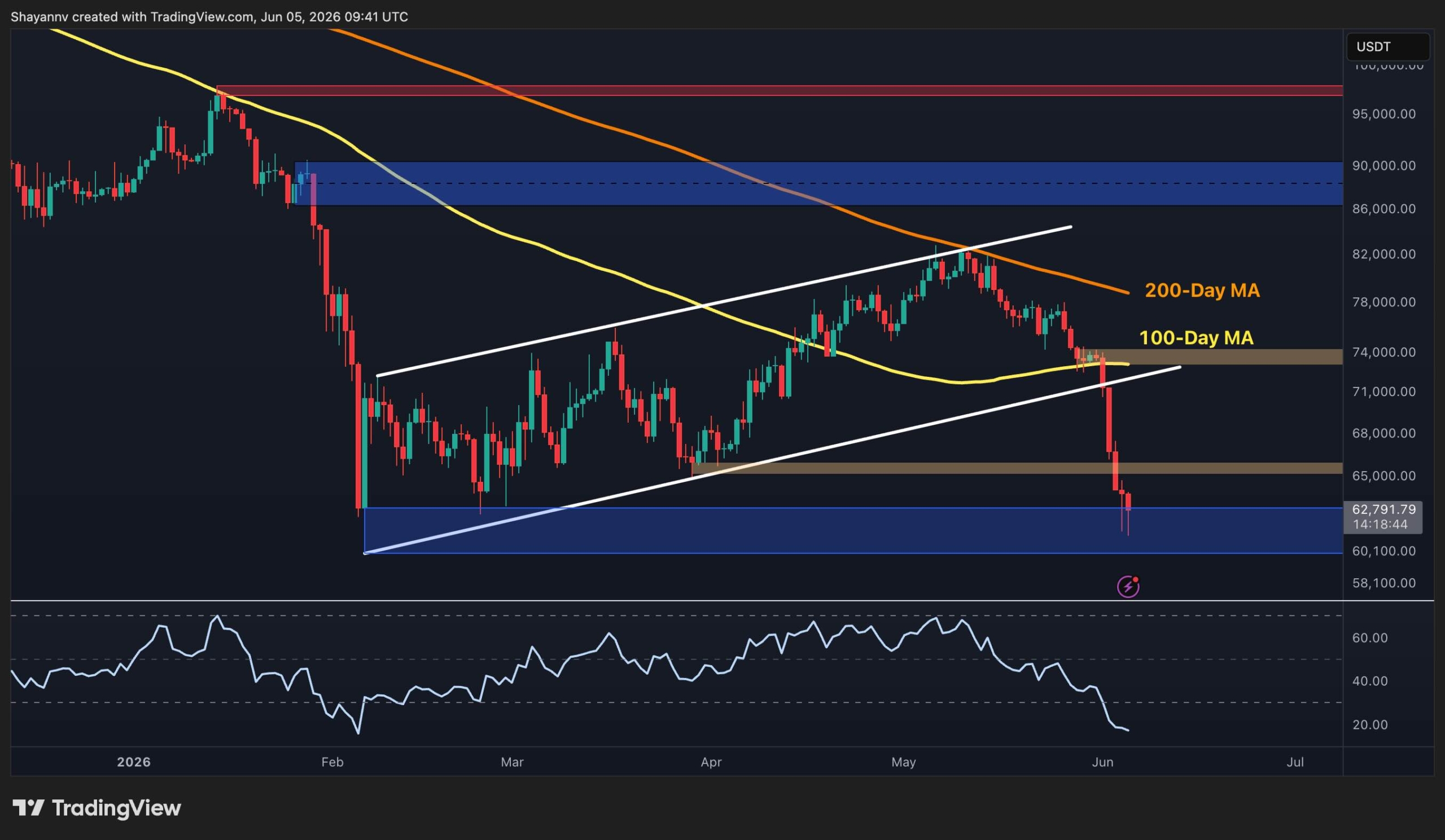
    Bitcoin is currently experiencing significant selling pressure, having rapidly fallen below multiple critical support levels. A recent rejection from the descending 200-day moving average triggered a sharp sell-off, invalidating the prior rising channel and pushing BTC back towards a major demand zone around $60,000. Concurrently, on-chain data indicates that market participants are increasingly realizing losses, signaling a deterioration in investor sentiment.

    Bearish Breakdown Confirmed

    On the daily chart, Bitcoin has confirmed a substantial bearish breakdown after dropping below both its ascending channel and the 100-day moving average, which had been situated near $74,000. This channel had previously supported the cryptocurrency’s recovery from February lows, but its recent violation suggests that buyers have lost control of the intermediate trend.

    The rejection occurred near the confluence of the channel’s upper boundary and the descending 200-day moving average, around the $82,000 mark. Since then, BTC has undergone an aggressive decline, slicing through the $74,000 support area and the significant low of $65,000 from late May with minimal resistance.

    The price is now testing a major support block at $60,000, a level that previously served as a strong rebound area following the February capitulation. This zone represents the last significant line of defense for bulls before the market potentially opens the door to substantially lower levels.

    Severity of Breakdown Evident on Shorter Timeframes

    The 4-hour chart underscores the severity of the recent breakdown. Following an extended period of consolidation near the $74,000 region, BTC failed to reclaim this level and subsequently broke below the lower boundary of the daily ascending channel that had supported price action for months.

    As the breakdown accelerated, the $65,000 support area also gave way, driving the price directly into the $60,000-$62,000 demand region. This area is currently acting as a floor, preventing further downside and has already attracted some buying interest.

    An important observation comes from the Relative Strength Index (RSI), which has formed a mild bullish divergence under extremely oversold conditions while the price has established fresh local lows. Although this signal is still in its early stages, it suggests that bearish momentum may be weakening in the short term and could support a temporary rebound towards the $65,000 resistance zone.

    However, from a structural perspective, the market continues to print lower highs and lower lows. As long as BTC remains below the broken support levels at $65,000 and $74,000, any recovery is likely to be viewed as a corrective move rather than the commencement of a new uptrend.

    On-Chain Data Signals Widespread Losses

    The Adjusted Spent Output Profit Ratio (aSOPR), a metric that measures whether coins moved on-chain are being sold at a profit or loss, is providing a significant signal regarding investor behavior.

    The chart indicates that the 30-day Exponential Moving Average (EMA) of aSOPR has fallen below the critical 1.0 threshold. Historically, readings above 1 signify that market participants are realizing profits on average, while values below 1 suggest that coins are being spent at a loss.

    The recent drop below 1 coincides with Bitcoin’s decline towards the $60,000 area and reflects growing capitulation among holders. This shift suggests that a larger proportion of investors are now exiting positions at a loss, a behavior commonly associated with bearish market phases and periods of weak confidence.

    While persistent readings below 1 often accompany downtrends, they can also signal the later stages of a corrective phase as weaker hands exit the market. Therefore, traders should closely monitor whether aSOPR can reclaim the 1.0 level. A recovery above that threshold would indicate renewed profitability across the network and could support broader market stabilization.

    For now, both price action and on-chain data continue to favor sellers, with the $60,000 support region remaining the key battleground that will likely determine Bitcoin’s next major directional move.

  • Bitcoin Dips Near $60K Amid Strategy Sell-Off; Zcash Faces Critical Vulnerability

    Bitcoin Dips Near $60K Amid Strategy Sell-Off; Zcash Faces Critical Vulnerability

    Crypto Markets Suffer Steep Losses as Bears Dominate

    The cryptocurrency markets endured a tumultuous week, largely dictated by a strong bearish sentiment.

    The preceding weekend saw a subdued trading environment, with Bitcoin (BTC) already having fallen to $74,000 from its May peak of nearly $83,000. However, the most significant downturn was yet to come. As the new business week and month commenced on Monday, Bitcoin experienced a rapid and sharp decline. It initially dropped towards the $70,000 mark. While this psychological level provided temporary support, it ultimately failed, leading to a swift deterioration of the market landscape.

    Cryptocurrencies continued to shed key support levels sequentially, with every attempt at a rebound being quickly suppressed. Bears appeared to be firmly in control throughout the week, including on Friday. Earlier in the day, BTC dipped below $62,000 once more, falling to $61,000. Within minutes, it rebounded to $63,000, a move that paradoxically fueled liquidations across the market before the asset was again rejected.

    The latest downward movement occurred just minutes ago, with Bitcoin slumping below $61,000 to reach a fresh four-month low. Consequently, the cryptocurrency has now lost well over $20,000 from its mid-May high and is currently struggling to maintain its position above the critical $60,000 support level.

    The weekly decline is stark and undeniable. Bitcoin has plummeted by 15% since this time last Friday and a substantial 26% over the past month. Its market capitalization has decreased by over $400 billion in recent weeks, now standing at $1.2 trillion according to CoinGecko. Even Bitcoin’s dominance over altcoins has weakened, despite many alternative cryptocurrencies experiencing similar or even more severe price drops.

    Among the notable decliners, Cardano (ADA) has fallen by over 30% following co-founder Charles Hoskinson’s announcement of a temporary break. Zcash (ZEC) saw a 41% drop after the discovery of certain technical vulnerabilities.

    Market Cap: $2.18T | 24H Vol: $138B | BTC Dominance: 55.7%
    BTC: $60,650 (-15.5%) | ETH: $1,600 (-17%) | XRP: $1.11 (-14%)

    Key Developments and Market Reactions

    Strategy Sold Bitcoin, But It’s Not What You May Think
    Bitcoin’s significant price struggles began shortly after Strategy announced its first sale of the cryptocurrency in years. Although the firm disposed of a very small portion of its Bitcoin holdings, the move triggered a notable reaction within the community and may have contributed to a significant downturn in overall market sentiment.

    Peter Schiff Warns Bitcoin Could Plunge Below $20K as Complacency Sets In
    In a widely anticipated commentary on X, Peter Schiff capitalized on Bitcoin’s price crash, predicting an even more dire scenario of a decline to $20,000 if the $50,000 support level is breached.

    Strive Doubles Down on Bitcoin With $185M Buy, Holdings Near 19,000 BTC
    In contrast to Strategy’s sale, Strive made its first purchase in a considerable period, expanding its Bitcoin holdings to nearly 19,000 BTC after a substantial $185 million acquisition.

    Arthur Hayes Dumps Entire Zcash (ZEC) Position After Major Flaw Emerges
    Shortly after news of Zcash’s technical issues gained traction on X, Arthur Hayes, a long-time supporter of the project, announced he had divested his entire ZEC position, citing significant uncertainty.

    Cardano (ADA) Faces Make-or-Break Moment as Social Buzz and Network Activity Explode
    Hoskinson’s break, coupled with ADA’s sharp price decline, has coincided with a surge in Cardano’s social media activity and network engagement, creating a pivotal moment for the project.

    Ethereum Crashing to 14-Month Low Is a ‘Screaming Buy-The-Dip Opportunity’ – Analyst
    Ethereum (ETH) was not immune to the broader market downturn, falling to consecutive 14-month lows, first below $1,800 and then to $1,600. However, some analysts view this significant price drop as a prime opportunity to buy the dip.

    This week’s analysis includes charts for Ethereum, Ripple, Cardano, Binance Coin, and Hyperliquid.

  • Hayes Sells Zcash, Bets Big on Worldcoin

    Hayes Sells Zcash, Bets Big on Worldcoin

    Hayes Ditches Zcash After Vulnerability Disclosures

    Arthur Hayes has announced that his fund, Maelstrom, has liquidated its entire Zcash (ZEC) holdings. The decision follows new disclosures regarding a vulnerability in the Zcash Orchard Pool, which Hayes believes has significantly heightened the perceived risk to ZEC’s monetary integrity. This move effectively marks the end of his recent “Holy Trinity” trade, which encompassed ZEC, NEAR, and HYPE. Worldcoin (WLD) remains the sole AI-linked asset in the fund’s portfolio, according to Hayes.

    “The Holy Trinity is dead,” Hayes declared on the social media platform X. “Sadly, due to the Orchard Pool exploit, I had to dump our entire ZEC bag.”

    The Orchard Pool Vulnerability and Market Reaction

    Hayes’ announcement came shortly after a detailed statement from Zooko Wilcox, Jason McGee, and Taylor Hornby, who characterized the issue as “The Orchard Counterfeiting Vulnerability.” According to their summary, Hornby discovered a critical flaw in Zcash’s Orchard pool on May 29. This vulnerability was disclosed to the Zcash Open Development Lab (ZODL), which then orchestrated an emergency response that concluded on June 2. The core of the problem, as stated, was that the vulnerability “could have been exploited to undetectably create an unlimited amount of counterfeit ZEC within Orchard.”

    This disclosure fundamentally altered the market’s perception. Earlier communications from the Zcash ecosystem had emphasized that the vulnerability had been fixed, with no evidence of exploitation and user funds remaining secure. However, Wilcox, McGee, and Hornby introduced a crucial caveat: due to the privacy features of Orchard, it is impossible to cryptographically prove whether the vulnerability was exploited during its existence.

    This distinction proved pivotal for Hayes’ decision to exit his Zcash position. “While I think it’s extremely unlikely of any minting, it cannot be formally cryptographically proved impossible,” Hayes explained. “The privacy from AI, govt, big tech narrative demands perfection not improbability. I read about the exploit yesterday, and didn’t appreciate how it violated my narrative mental map.”

    ZODL’s Explanation and the Impact of Uncertainty

    Josh Swihart, founder and CEO of ZODL, offered his perspective in a post titled “Never Again.” He described the Orchard bug as a failure in one of the system’s rules, noting that the rule was written with enough leniency to accept false information and still pass. Swihart clarified that the issue was not a privacy leak but a soundness failure within the proof system, a type of problem that can erode confidence in the possibility of invalid value creation within a shielded pool.

    The emergency fix necessitated a coordinated network-wide action, rather than a simple software update for wallets or applications. ZODL and the broader Zcash community temporarily disabled Orchard operations before restoring them with a corrected circuit. While the remediation addressed the vulnerability, the residual uncertainty surrounding the event cast a shadow over the privacy-focused asset. The absence of evidence of counterfeiting is not equivalent to a cryptographic guarantee that counterfeiting never occurred.

    Reassessment and Future Outlook

    Hayes indicated that the approximately 30% sell-off in ZEC prompted a reassessment of his position. “The 30% dump made me rethink, and I had to take profit on the entire position,” he stated. His rationale was not based on confirmed exploitation, but on the principle that the privacy thesis he associated with ZEC demanded a higher standard than probabilistic assurances.

    This sale marks a swift reversal from Hayes’ May 22 “Holy Trinity” call, where he had identified HYPE, ZEC, and NEAR as a promising trio. At the time, he had described HYPE as representing the on-chain derivatives and protocol revenue trade, NEAR as the AI and chain-abstraction play, and ZEC as the privacy component.

    Just a day prior to divesting his Zcash holdings, Hayes had already announced the sale of his HYPE and NEAR positions, citing rising energy prices, anticipated major AI initial public offerings, and political risks surrounding artificial intelligence as reasons for taking profits.

    Despite his exit from Zcash, Hayes has not entirely closed the door on the asset. “We will consistently re-evaluate our thinking and if my assumptions are proven incorrect, will rebuy, hopefully at lower prices,” he wrote. “Privacy is priceless and I have no issue eating humble pie and rebuying much higher.”

    For the time being, Worldcoin remains the sole public manifestation of his AI-linked investment strategy. “We still hold WLD and are excited for Lord Elon to pump our bags,” Hayes added, referencing recent speculation around AI assets and an OpenAI IPO that has fueled renewed interest in Worldcoin.

    At the time of reporting, ZEC had experienced a decline of over 45% in the preceding 24 hours.

  • Hayes Dumps Zcash After Four-Year Counterfeit Bug

    Hayes Dumps Zcash After Four-Year Counterfeit Bug

    Hayes Liquidates Zcash Holdings Amidst Protocol Vulnerability

    Arthur Hayes, co-founder of BitMEX, confirmed on Tuesday that he has divested his entire Zcash (ZEC) holdings following the discovery of a critical bug within the protocol’s Orchard Pool. The vulnerability, which affects Zcash’s core shielded transaction layer, compounds a challenging period for the cryptocurrency.

    This liquidation marks the complete unwinding of Hayes’s self-proclaimed “Holy Trinity” portfolio, which previously comprised HYPE and NEAR tokens.

    Hayes announced the move on social media, stating, “The Holy Trinity is dead. Sadly due to the Orchard Pool exploit, I had to dump our entire $ZEC bag. While I think it’s extremely unlikely of any minting, it cannot be formally cryptographically proved impossible – The privacy from AI, govt, big tech narrative demands perfection…”

    The market is now grappling with whether Hayes’s decision was a calculated assessment of protocol risk or a reactive sell-off triggered by a flaw that undermined his confidence in privacy-focused cryptocurrencies as a category. Evidence suggests the former, a distinction that holds significance for those interpreting his exit as a market signal.

    Orchard Pool Vulnerability Detailed

    The Orchard Pool represents Zcash’s latest generation of shielded transaction circuitry, introduced with the NU5 upgrade in May 2022. It superseded the older Sapling pool and incorporated trustless zk-SNARKs through the Halo 2 proving system, eliminating the need for a trusted setup. The pool’s primary function is to facilitate fully private transactions, making its cryptographic integrity the cornerstone of ZEC’s value proposition.

    The bug, identified on May 29, 2026, by Shielded Labs security engineer Taylor Hornby, was attributed to an insufficient constraint in elliptic-curve multiplication within the halo2_gadgets crate. Hornby utilized AI-assisted formal methods, including Anthropic’s Claude Opus 4.8, in his discovery.

    In simpler terms, the flaw meant that specially crafted inputs could theoretically circumvent the circuit’s validation checks, potentially leading to the creation of counterfeit ZEC that would still pass Orchard’s verification processes.

    An emergency hard fork was implemented on June 3, 2026, to address the vulnerability. However, the period between the NU5 activation in 2022 and the June 2026 patch represents nearly four years during which the bug remained undetected, despite undergoing multiple expert audits.

    Implications for Holders and Market Sentiment

    A crucial aspect for ZEC holders is that, due to Orchard’s privacy architecture, it is cryptographically impossible to definitively prove that no counterfeit ZEC was minted during the four-year window. While there is no evidence of exploitation, the inability to guarantee total supply integrity represents a fundamental challenge to the “sound money” narrative that Electric Coin Co. has cultivated around ZEC.

    Hayes had previously identified Zcash as a high-conviction holding, classifying it as part of his “Holy Trinity” alongside HYPE and NEAR, which he described as his asymmetric altcoin investments. He had already liquidated his positions in HYPE and NEAR before turning his attention to ZEC, a sequence that some interpret as a methodical risk reduction rather than a panicked reaction.

    Hayes’s ZEC exit followed the public disclosure of the Orchard bug and the June 3 hard fork, indicating that his decision was made after the vulnerability became known. His stated reason was direct: “The probability of unauthorized minting is extremely low, but it cannot be proven cryptographically impossible,” he explained. He further elaborated that “The narrative of protecting privacy from AI, governments, and Big Tech demands perfection, a standard the bug undermined.”

    This rationale is framed not as a trader’s justification but as a thesis-driven decision. Hayes’s investment in ZEC was predicated on privacy coins occupying a unique ideological and technical niche, one that demands absolute cryptographic certainty, a standard that the Orchard bug has now compromised.

    This pattern of investment and exit is familiar to followers of Hayes’s public portfolio movements. He typically demonstrates strong conviction, offers public endorsement, and then executes a clean exit when the underlying thesis falters. Whether this constitutes disciplined risk management or a “shill, pump, dump, repeat” cycle, as previously documented, is a matter of interpretation. However, the Orchard bug provides a more substantial fundamental rationale for this exit than many previous instances. Hayes continues to hold Worldcoin (WLD), which was not part of the Trinity framework.

    Market Reaction and Technical Outlook

    Following the public disclosure of the bug, ZEC experienced a significant price drop, falling between 30% and 36% from its recent highs. The cryptocurrency declined from over $600 to approximately $390, resulting in a market cap reduction exceeding $3 billion.

    The price action saw ZEC break below its 20-day, 50-day, and 100-day exponential moving averages (EMAs) in succession. Traders are now closely monitoring the 200-day EMA support level, situated near $367, as the next critical price point.

    Hayes’s own exit occurred on average trading volumes, suggesting that his position did not mechanically influence the price; the market had already begun pricing in the protocol risk prior to his announcement.

    The current technical outlook for ZEC remains bearish until the $430–$450 zone is reclaimed on a closing basis. A break below $367 would usher ZEC into uncharted technical territory with limited historical support to draw upon.

  • Zcash Plummets 38% on Critical Counterfeiting Vulnerability Disclosure

    Zcash Plummets 38% on Critical Counterfeiting Vulnerability Disclosure

    Zcash Suffers Double-Digit Plunge After Critical Vulnerability Disclosure

    Zcash experienced a significant overnight drop of more than 10% after developers revealed a critical vulnerability in the protocol’s Orchard shielded pool. The flaw, which had the potential to allow undetectable counterfeiting for over four years, sent the privacy coin’s value plummeting.

    According to CoinGecko data, Zcash fell from a local high of $635 on Wednesday to an intraday low of $309 on Thursday. The cryptocurrency has since seen a slight recovery, trading around $330, marking a 37.8% decrease for the day.

    Vulnerability Details

    The security flaw was identified on May 29 by researcher Taylor Hornby, who utilized AI-assisted auditing tools. The vulnerability was located within two lines of code in the Orchard circuit, the cryptographic component responsible for Zcash’s shielded transactions. It would have enabled a malicious actor to create counterfeit ZEC within the shielded pool without leaving any on-chain trace. If exploited before its discovery, there would have been no cryptographic means to prove that counterfeiting had occurred.

    Shielded Labs, the organization spearheading Zcash development, stated in a disclosure post that the vulnerability was present from Orchard’s activation in May 2022 until an emergency fix was implemented on June 1, 2026. “Due to the privacy properties of Orchard and the nature of the bug, there is no definitive way to determine, using only cryptography, whether such exploitation occurred,” the post read.

    Reignited Debate on Privacy Coin Risks

    The incident has intensified discussions surrounding a perceived structural issue within privacy coins. Critics argue that, unlike Bitcoin or Ethereum where on-chain exploits are readily apparent, privacy-focused cryptocurrencies like Zcash can conceal successful attacks, making detection impossible.

    “Zcash enables a unique class of bugs where if they’re exploited, no one would know,” commented crypto analyst Udi Wertheimer on social media. “This unique class still exists. The fact that they fixed this specific bug is immaterial.”

    Joe Andrews, CEO of Aztec Labs, a privacy-focused product studio, noted that under-constrained elliptic curve checks, the category of flaw at the core of this vulnerability, are a common weakness in ZK circuits. He added that AI is accelerating the discovery of such bugs across the industry. Andrews suggested that a long-term solution involves formal circuit verification coupled with a secondary proof system, an approach already being considered by Ethereum. “Both systems must agree for a state transition to be valid, which drastically lowers the chances of bugs being exploited,” he explained.

    Market Reaction and Potential Impact

    Arthur Hayes, former CEO of BitMEX, announced that he had divested his entire Zcash holdings following the disclosure. He expressed concern that while direct inflation from the exploit is unlikely, the Orchard pool itself could face insolvency. This could lead to the dilution of shielded ZEC holders if counterfeit assets were to compete with legitimate ones for a finite pool balance.

    However, not all industry figures share the same level of alarm. Craig Salm, chief legal officer at Grayscale, suggested that exploitation prior to the patch was improbable. He argued that proving such exploitation would require an individual to have a deeper understanding of the codebase than all core developers combined and to have resisted the temptation to drain the pool during a bull market. “Seems unlikely to me,” Salm tweeted.

    Proposed Solutions and Future Outlook

    Shielded Labs has put forth a proposal for a network upgrade that would introduce a new shielded pool featuring turnstile accounting. This mechanism would allow for independent verification of Zcash supply integrity.

    Andrews believes that the proposed upgrade, which mandates that all coins be unshielded before entering the new pool, effectively limits the risk of prior exploitation to the current volume of shielded assets. “Formal verification of the new upgrade reduces risks substantially further,” he stated.